

 14 Jul 2026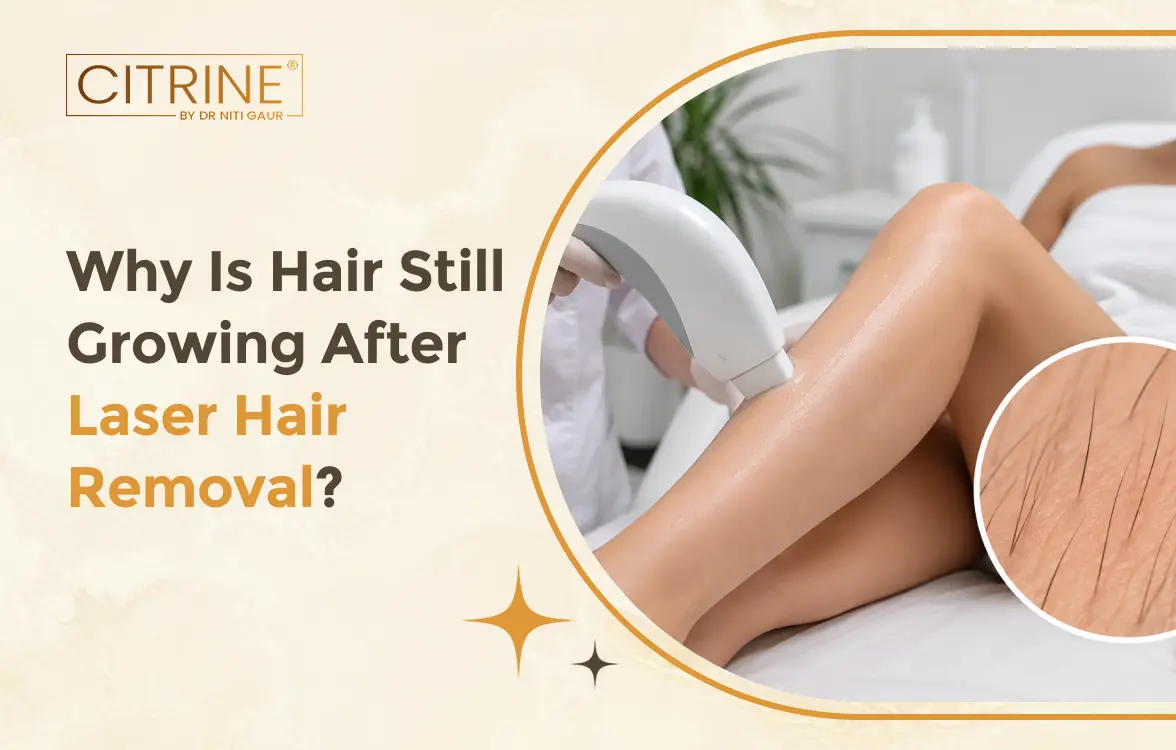
You booked laser hair removal expecting smoother skin, yet hair is visible again days or weeks later. In most cases, this does not mean treatment has failed.
Laser works gradually and affects only follicles in the right growth phase. Treated hairs may remain temporarily and look as though they are growing while being pushed out. True regrowth can still occur because of resting follicles, hormones, unsuitable technology, low settings, or an incomplete course. In this blog, we will discuss why hair still grows after getting laser hair removal.
Key Takeaways
- Hair seen 1 to 3 weeks after treatment may be shedding, not new growth.
- Laser works best on dark hair in the active growth phase.
- Patchy, slower, or finer regrowth between sessions is usually normal.
- Hormones, fine or light hair, wrong intervals, and unsuitable settings can reduce results.
- Hair becoming coarser around the treated area needs medical review.
- Safe treatment matches the wavelength and settings to your skin, hair, and body area.
Understanding the Basics of Laser Hair Removal
Laser hair reduction uses concentrated light to damage hair follicles and slow future growth.
Hair shedding is the release of a treated hair shaft, usually over several days or weeks.
Hair regrowth means a follicle has produced another visible hair. It may come from a follicle that was resting, was only partly damaged, or became active because of hormones.
Laser targets melanin, the pigment in hair. Dark, coarse hair generally responds better than grey, white, blonde, red, or very fine hair. Device selection is especially important for brown and darker skin.
How Does Laser Hair Removal Work?
A controlled pulse travels through the skin toward pigmented hair. The heat may stop a follicle from producing hair, slow its activity, or make the next hair finer.
Results build over time. The American Academy of Dermatology notes that patients may see about 10% to 25% reduction after the first treatment. Several sessions are usually required.
Lasers do not treat the cause of excess growth. Hormonal changes and some medicines may activate new follicles after treatment.
What Is the Role of Hair Growth Cycles in Treatment Success?
Hair follicles do not grow together, so sessions must be spaced apart.
| Hair Phase | What Happens | Laser Response |
| Anagen | Hair is actively growing and attached to the follicle | Best response because pigment carries heat toward the growth structures |
| Catagen | Growth stops and the follicle begins to shrink | Less responsive |
| Telogen | The follicle rests before a new cycle begins | Poor response because there may be little active hair to target |
Research supports that actively growing anagen follicles are more sensitive to laser injury than catagen or telogen follicles.
Why Is My Hair Growing Back After Laser Sessions?
Treated hair is shedding.
Hair does not fall out immediately. It may look longer while the skin pushes the damaged shaft outward. This usually happens over several days to weeks. Do not pull it out.
Resting follicles have become active.
Follicles in catagen or telogen were poor targets at the previous visit. Once they enter anagen, visible hair appears. This is expected.
The course is incomplete or poorly timed.
One or two visits cannot treat every growth cycle. Sessions that are too early, too late, or frequently missed may slow progress. Facial and body areas also need different intervals.
Hormones are stimulating new hair.
Facial and neck hair are particularly hormone-sensitive. Sudden coarse facial hair with irregular periods, acne, scalp thinning, or voice change should be medically assessed.
The hair has too little pigment.
Grey, white, very blonde, and many red hairs respond poorly. Fine peach fuzz may also absorb too little energy and can be a poor laser target.
The technology or settings are unsuitable.
Low energy may be ineffective, while excessive energy may cause burns or pigment changes. Good treatment requires the right wavelength, settings, cooling, and technique.
Is Regrowth Normal Between Sessions?
Usually, yes. The pattern matters more than the presence of hair.
| What you notice | Likely meaning | Next step |
| Dark dots or stubble moving outward during the first 1 to 3 weeks | Normal shedding | Wait and cleanse gently |
| Patchy, slower, finer regrowth | Expected response | Continue the planned course |
| Little change after several well-timed sessions | Possible poor response, wrong settings, or hormonal influence | Request a formal review |
| Denser, darker, or coarser hair in or around the area | Possible paradoxical hypertrichosis | Pause routine sessions and see a dermatologist |
Common Factors Affecting Laser Hair Removal Results
Results depend on skin tone, recent tanning, hair colour and thickness, treatment area, hormones, medicines, wavelength, settings, operator skill, session timing, and aftercare.
Track progress with photographs and shaving frequency. Look for lower density and finer regrowth.
Why the Technology Behind Your Laser Treatments Matters
Citrine Clinic uses a triple-wavelength platform using Alexandrite, Diode, and Nd:YAG wavelengths, along with cooling and adjustable settings.
| Technology | Common strength | Limitation |
| Alexandrite, 755 nm | Strong pigment absorption and efficient treatment of dark hair on lighter skin | Needs extra caution in darker or tanned skin |
| Diode, about 810 nm | Versatile for many skin tones and coarse body hair | Outcome depends heavily on device quality and settings |
| Nd:YAG, 1064 nm | Deeper penetration and often preferred for darker skin | Fine hair can be harder to treat |
A triple-wavelength label does not guarantee results. The provider must still choose and adjust suitable parameters. Ask which wavelength is being used and why.
Signs Your Laser Hair Removal Wasn’t Performed Correctly
One weak session does not prove poor care. Seek review if you notice:
- No consultation, medical history, or skin assessment
- No protective eyewear in the treatment room
- Identical settings for every skin tone and body area
- Repeated missed strips or sharply untreated lines
- No improvement after several appropriately timed sessions
- Severe pain, blistering, crusting, scarring, or lasting colour change
- Progressively thicker hair around treatment borders
- Guaranteed claims of 100% permanent removal
Mild redness and follicular swelling can be normal briefly. Blistering, severe pain, or persistent pigmentation is not something to ignore.
Common Mistakes That Reduce Laser Hair Removal Results
- Waxing, threading, epilating, or tweezing between visits
- Arriving tanned or not reporting sun exposure
- Skipping sessions without revising the schedule
- Treating fine facial fuzz without discussing limitations
- Judging success only by whether any hair is visible
- Choosing solely by package price
- Continuing unchanged settings despite poor response
- Ignoring signs of PCOS or another hormonal condition
Shaving is generally allowed because it leaves the follicle in place. Dermatologists advise avoiding waxing, plucking, and electrolysis before treatment.
What You Can Do to Improve Results
Follow the area-specific schedule, shave as advised, avoid root-removal methods, and protect the skin from tanning. Tell the provider about new medicines, pregnancy, sun exposure, skin reactions, and hormonal symptoms.
Ask for a progress review before automatically buying more sessions. The plan may need a different wavelength, revised timing, hormonal investigation, or electrolysis for isolated light-coloured hairs.
Maintenance Tips for Long-Lasting Laser Hair Removal Results
- Use broad-spectrum SPF 30 or higher on exposed treated skin.
- Avoid waxing or plucking when further laser is planned.
- Manage hormonal conditions with the appropriate clinician.
- Keep photographs and session records.
- Report unexpected thickening early.
Questions to Ask Your Provider
- Which wavelength suits my skin and hair, and why?
- Who performs the procedure and provides medical supervision?
- What result is realistic for this body area?
- How will progress and settings be reviewed?
- What are my risks of burns, pigmentation, or increased growth?
- Could my hair pattern suggest a hormonal condition?
- What happens if I do not improve after several sessions?
- What is included in the package and maintenance plan?
Final Takeaway
Hair regrowth after laser hair removal can be completely normal, especially during the shedding phase and between the first few sessions. As treatment progresses, the hair should generally become sparser, grow back more slowly, appear in patchier areas, and feel finer.
However, if hair growth remains unchanged after multiple sessions, becomes noticeably thicker, or is accompanied by persistent skin reactions, it may be time to reassess the treatment plan rather than simply repeating the same settings.
For a personalized evaluation, patients can consult Dr. Niti Gaur at Citrine Clinic. She can review factors such as skin type, hair characteristics, previous laser settings, and medical history to determine whether treatment should continue as planned, be adjusted, or be temporarily paused.
To book a consultation with Dr. Niti Gaur, visit Citrine Clinic now. You can also check patient reviews before visiting.
View Citrine clinic location, directions, and reviews on Google Maps
Frequently Asked Questions
1. Can I shave between laser sessions?
Yes. Shaving preserves the follicle target, unlike waxing, threading, or tweezing.
2. Can I pull out loose hairs?
Let them release naturally. Forceful plucking can irritate the skin.
3. Does laser work on grey or white hair?
Usually not well because these hairs have little or no melanin. Electrolysis may be an alternative.
4. Can lasers be done during pregnancy?
Many clinics postpone elective laser treatment because pregnancy safety data are limited.
5. Does menstruation affect results?
It usually does not affect effectiveness, although skin may feel more sensitive.
6. Can sun exposure affect treatment?
Yes. A tan raises the risk of burns and pigmentation and may require postponement or lower settings.
7. Is IPL the same as laser?
No. IPL uses broad-spectrum light, while lasers use specific wavelengths.
8. When should new facial hair be checked medically?
Seek assessment if growth is sudden or comes with irregular periods, acne, scalp hair loss, or other hormonal symptoms.
About the Author