
 13 Jul 2026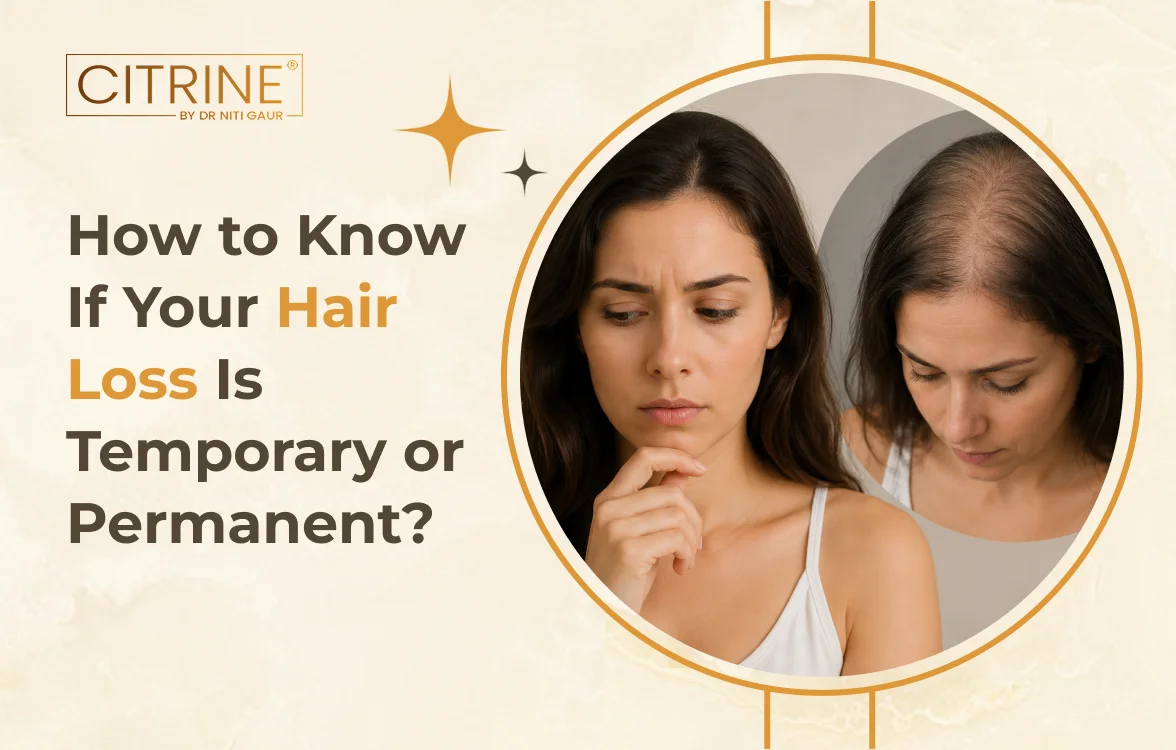
Hair loss can be stressful, confusing, and emotionally draining. One day you notice extra hair in the shower. Then it is on your pillow, your comb, your clothes, and suddenly every mirror check becomes stressful.
The biggest question is usually: “Will my hair grow back?”
The answer depends on the cause. Some hair loss is temporary and improves once the trigger is corrected. Some hair loss is progressive, meaning it slowly worsens without treatment. Some types can become permanent if the hair follicles are damaged or scarred.
The good news is that early diagnosis can make a real difference. The not-so-good news is that waiting too long, using random products, or assuming all hair fall is the same can delay proper care.
This blog explains the difference between temporary hair loss and permanent hair loss, what signs to watch for, and when to see a dermatologist.
Quick Summary
- Sudden hair shedding after fever, stress, childbirth, surgery, weight loss, or illness is often temporary.
- Gradual thinning at the crown, temples, or part line may suggest pattern hair loss.
- Patchy hair loss can happen with alopecia areata, fungal infection, or inflammatory scalp conditions.
- Pain, burning, scaling, redness, pustules, or shiny bald patches need early medical attention.
- Temporary shedding usually improves, but recovery may take several months.
- Permanent hair loss is more likely when follicles shrink, scar, or stop producing visible hair.
- A dermatologist can check whether your follicles are active, weak, inflamed, or permanently damaged.
What Is Temporary Hair Loss?
Temporary hair loss means the hair follicle is still alive and capable of growing hair again. The hair may shed heavily for a period, but the follicle is not permanently destroyed.
The most common type is telogen effluvium, a condition where more hairs than usual shift into the resting phase of the hair cycle. This often happens after a physical or emotional trigger.
Common triggers include:
- High fever or infection
- Childbirth
- Major emotional stress
- Surgery
- Crash dieting
- Sudden weight loss
- Low iron, vitamin D, B12, or protein intake
- Thyroid imbalance
- New medication or medication changes
- Severe dandruff or scalp inflammation
Temporary hair loss often appears two to three months after the trigger, not immediately. This delay is one reason many people struggle to connect the cause with the shedding.
What Is Permanent Hair Loss?
Permanent hair loss means the follicle has become too weak, scarred, miniaturized, or inactive to produce normal hair again.
This does not always mean there is no treatment. Instead of simply waiting for hair to come back, treatment focuses on saving active follicles, slowing progression, improving thickness, and planning advanced options if needed.
Permanent or progressive hair loss may happen with:
- Androgenetic alopecia, also called male or female pattern hair loss
- Long-standing traction alopecia from tight hairstyles
- Scarring alopecia
- Untreated inflammatory scalp disease
- Advanced baldness where follicles are no longer active
How Do You Know If Hair Loss Is Temporary?
Signs your hair loss may be temporary include:
- Hair fall started suddenly.
- You had fever, illness, childbirth, stress, surgery, or weight loss in the last few months.
- Hair is shedding from the entire scalp rather than one fixed area.
- Your hairline is not clearly receding.
- The part line is not steadily widening.
- The scalp does not look shiny, scarred, red, or painful.
- You notice short new baby hairs after a few months.
- Hair fall slowly reduces instead of worsening every month.
It is normal to shed some hair daily. The American Academy of Dermatology says losing 50 to 100 hairs a day is normal and does not automatically mean hair loss.
A practical way to track progress is to take photos once a month in the same lighting, with the same hairstyle and same camera angle. Checking every day usually increases anxiety and makes small changes look worse than they are.
How Do You Know If Hair Loss May Be Permanent?
Signs that hair loss may be permanent or progressive include:
- Gradual thinning at the crown
- Receding hairline
- Widening middle part
- Reduced ponytail thickness over time
- Visible scalp in areas that were previously dense
- Family history of baldness or thinning
- Hair strands becoming finer or shorter
- Smooth bald patches that do not fill in
- Shiny scalp with no visible follicle openings
- Burning, itching, scaling, tenderness, redness, or pus bumps
These signs should not be ignored. Scarring forms of hair loss can destroy follicles. Once a follicle is scarred, regrowth is limited or not possible.
How Dermatologists Diagnose the Type of Hair Loss
A good hair loss consultation should not be limited to a quick glance at the scalp. The cause is often found by combining history, examination, and targeted tests.
A dermatologist may check:
- When the hair loss started
- Whether it is shedding, thinning, patchy loss, or breakage
- Recent fever, stress, illness, childbirth, surgery, or weight loss
- Diet history
- Medication history
- Menstrual history and acne in women
- Family history of hair thinning
- Scalp itching, pain, scaling, redness, or dandruff
- Hairstyling habits
- Hair density and follicle activity under magnification
Tests may include:
- Hair pull test
- Trichoscopy or scalp magnification
- CBC
- Ferritin and iron studies
- Thyroid profile
- Vitamin D and B12 levels
- Hormonal evaluation when required
- Fungal testing
- Scalp biopsy if scarring alopecia is suspected
Effective hair loss treatment begins with identifying the cause, and dermatologists can diagnose whether a person has hair loss, excessive shedding, or both.
At Citrine Clinic, Dr. Niti Gaur evaluates hair loss by looking at the pattern, scalp condition, medical history, possible triggers, and follicle activity. This helps separate temporary shedding from progressive thinning and avoids one-size-fits-all treatment.
Common Mistakes People Make With Hair Loss
Many patients lose valuable time because they try to treat hair fall without knowing the cause.
Avoid these common mistakes:
- Buying random “anti-hair fall” products without diagnosis
- Taking high-dose supplements without testing
- Assuming all hair fall is due to stress
- Ignoring a widening part because shedding is not severe
- Using oils aggressively on an itchy or inflamed scalp
- Stopping treatment after one month because results are slow
- Continuing tight ponytails, buns, extensions, or braids despite hairline thinning
- Believing hair transplant is the first solution for every case
- Waiting too long when there is scalp pain, burning, scaling, or shiny bald skin
No treatment works for everyone. There is no hair loss treatment that is 100% effective. This is why expectations need to be realistic from the beginning.
What Treatments Can Help?
Treatment depends on the diagnosis. The same treatment that helps one patient may be useless for another.
| Treatment Option | When It May Help |
| Medical treatment such as minoxidil or prescribed medicines | Pattern hair loss, selected chronic shedding, early thinning |
| Deficiency correction | Low ferritin, vitamin D, B12, zinc, or protein-related shedding |
| Scalp treatment | Dandruff, psoriasis, folliculitis, fungal infection, itching, scaling |
| PRP or GFC therapy | Early to moderate thinning with active follicles |
| Mesotherapy or growth-factor support | Weak hair growth or early thinning in selected cases |
| Anti-inflammatory treatment | Alopecia areata or scarring/inflammatory scalp conditions |
| Hair transplant | Stable bald areas with good donor hair |
| Low-level laser or adjunctive care | Mild to moderate thinning |
Mayo Clinic notes that minoxidil may help some people regrow hair or slow hair loss, but it can take at least six months to judge early benefit and continued use may be needed to maintain results.
At Citrine Clinic, treatment options for hair loss include medical management, nutritional correction, scalp inflammation treatment, PRP, GFC, mesotherapy, and hair transplant when suitable. Dr. Niti Gaur may recommend one option or a combination, depending on the cause, stage, scalp health, and patient expectations.
When Should You See a Dermatologist?
You should see a dermatologist if:
- Hair fall continues for more than 6 to 8 weeks.
- Your part line is widening.
- Your hairline is receding.
- You notice bald patches.
- Your scalp is itchy, painful, red, scaly, or tender.
- You see pus bumps or sores.
- Hair loss started after a new medicine.
- You have irregular periods, acne, weight changes, or excess facial hair.
- Hair density has not improved after several months.
- You are considering PRP, GFC, minoxidil, oral medicines, or hair transplant.
You should not wait if the scalp looks shiny, scarred, or inflamed. In those cases, time matters because follicle damage may become permanent.
Final Takeaway
Temporary hair loss usually means the follicle is stressed but still active. Permanent hair loss means the follicle is shrinking, scarred, damaged, or inactive. The earlier you identify which one you have, the better your chances of protecting your hair.
Do not panic after one bad hair fall week. At the same time, do not ignore gradual thinning, a widening part, a receding hairline, bald patches, scalp pain, scaling, or shiny skin.
If you are unsure whether your hair loss is temporary or permanent, a dermatologist-led evaluation can save time and prevent the wrong treatment.
At Citrine Clinic, Dr. Niti Gaur offers diagnosis-based hair loss care, including medical treatment, scalp treatment, nutritional correction, PRP, GFC, mesotherapy, and hair transplant when appropriate.
To book your consultation with Dr. Niti Gaur, visit Citrine Clinic now.
View Citrine clinic location, directions, and reviews on Google Maps
FAQs
1. How can I tell if my hair loss is temporary?
Temporary hair loss usually starts suddenly after stress, fever, illness, childbirth, weight loss, or a diet change. The scalp often looks normal.
2. How long does temporary hair loss last?
Many cases improve within three to six months, but visible fullness may take longer because hair grows slowly.
3. Can permanent hair loss grow back?
If follicles are weak but active, treatment may improve thickness. If follicles are scarred or inactive, regrowth is limited.
4. Is stress-related hair loss permanent?
Stress-related shedding is often temporary, but it can reveal underlying pattern hair loss in some people.
5. Does a widening part mean permanent hair loss?
A widening part can suggest female pattern hair loss, especially if it develops gradually. A dermatologist can confirm the cause.
6. Can low iron cause hair loss?
Yes, low ferritin or iron deficiency can contribute to shedding. Testing is better than guessing with supplements.
7. Is alopecia areata temporary or permanent?
Alopecia areata can regrow, but it may also persist or relapse.
8. Can tight hairstyles cause permanent hair loss?
Yes. Early traction alopecia may improve if pulling stops, but long-term tension can damage follicles permanently.
9. Should I start minoxidil for hair fall?
Not without knowing the cause. Minoxidil can help some types of thinning, but it is not the right answer for every hair fall case.
10. When is hair transplant needed?
Hair transplant may be considered when hair loss is stable, bald areas have inactive follicles, and the donor area is healthy.
About the Author