
 07 Aug 2026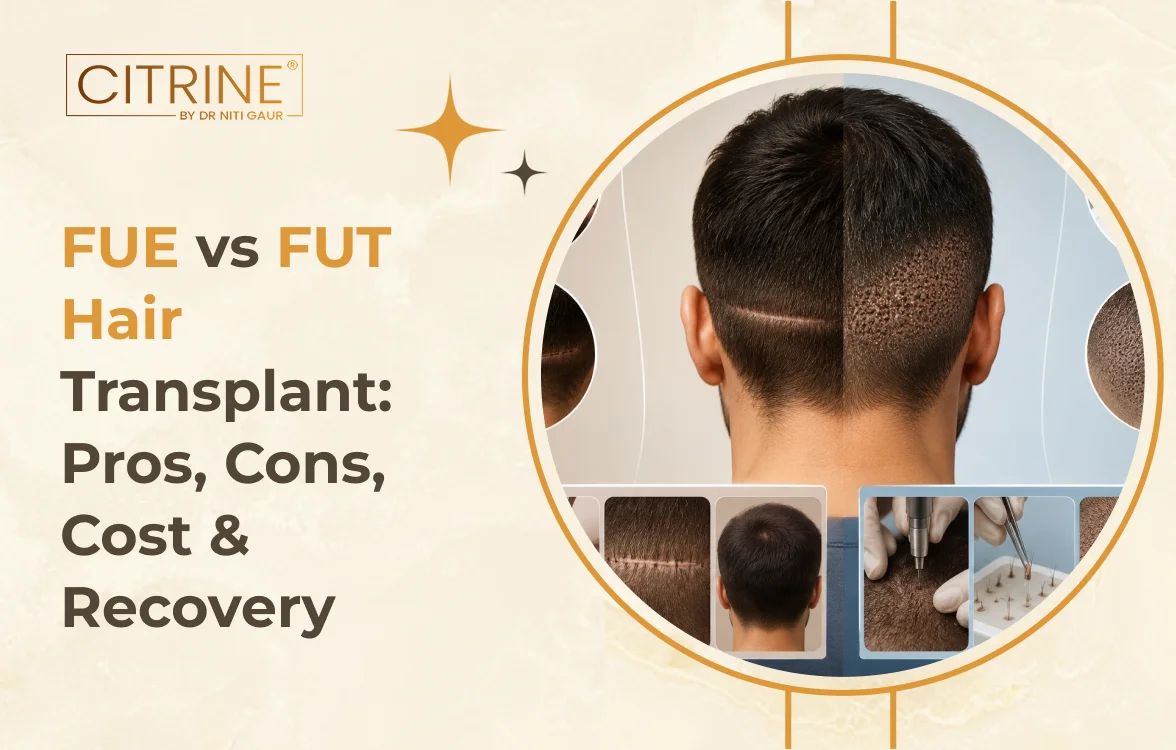
Hair transplants are rising in demand in Delhi among male and female hair loss sufferers who have only surgical hair restoration as a viable option for long-lasting relief from pattern baldness. If you are at this stage, you will have to choose between two hair transplant techniques: Follicular Unit Extraction (FUE) and Follicular Unit Transplantation (FUT).
Both FUE and FUT have the same goal- the transfer of viable hair follicles from the areas genetically resistant to baldness to hair-thinning or bald regions. However, they vary in how the hair grafts are harvested, recovery time, scarring, suitability, and cost.
Here’s an expert-backed comparison of FUE and FUT hair transplants to help you make an informed decision during your consultation with your hair restoration surgeon before getting a hair transplant in Gurgaon.
Quick Summary About FUE vs FUT Hair Transplant
- FUE: Minimal scarring, faster recovery, ideal for hairline and smaller graft sessions.
- FUT: Better for extensive baldness and higher graft requirements.
- FUE is usually more expensive than FUT.
- FUT leaves a linear scar; FUE leaves tiny dot-like scars.
- Final visible results typically appear within 12–18 months.
The FUE (Follicular Unit Extraction):
- Advanced, minimally invasive method where hair follicles are directly extracted one by one from the donor area using a micro-punch tool and then implanted into pre-made slits of the recipient area
- Leaves hardly visible, tiny dot-like scars
- Best for harvesting of small number of grafts; natural hairline, eyebrow, beard/moustache restoration
The FUT (Follicular Unit Transplantation):
- Traditional approach where a linear incision is made at the back of the head to remove a thin strip of scalp bearing healthy hair follicles
- The strip is dissected under a microscope to extract individual hair follicle units, which are next carefully placed in pre-made slits of the recipient area.
- Leaves a linear scar at donor site
- Best for harvesting large number of grafts; large areas of hair thinning/baldness
- In either case, noticeable hair growth takes 6 to 9 months, and outcomes are apparent in 12 to 18 months.
How is FUE Different from FUT Hair Transplant?
Here are the key distinguishing features of FUE and FUT:
| Features | FUE | FUT |
| Harvesting method | Direct extraction of the individual hair follicle units using a micro-punch device | Extraction of the hair follicle units from the hair-bearing scalp strip, taken from the back of the head and dissected under a microscope. |
| Scarring | Tiny, circular extraction sites become scars that are hardly visible even in short hair. | A linear scar of a few mm that can only hide behind long, existing hair |
| Need for hair trimming/shaving. | Usually needed | Often minimal to no trimming required |
| Need for sutures | No making of incisions, so no use of stitches | Stitches required to close the linear incision at donor area |
| Procedure duration | 6-10 hours | 4-8 hours |
| Recovery time | Shorter | Slightly longer |
| Downtime | 5-10 days | 10-14 days |
| Standard range of grafts that can be harvested in one session | 2,000 to 3,000 | 2,000 to 3,500 |
| Transection rate (count of damaged grafts with every session) | 2 to 5% | 1 to 2% (means higher graft survival) |
| Level of discomfort | Minimal to none; lasting for 1-2 days | Moderate; tenderness, soreness, and tightness last for 3-5 days |
| Recommended for | Early to moderate hair loss of the scalp, eyebrow, or beard/moustache | Advanced stage of hair thinning/hair loss |
| Cost | Higher | Lower |
Who is a good candidate for FUE or FUT?
A good candidate is someone with:
- Stable hair loss
- Adequate donor hair
- Realistic expectations
- Good overall health.
A detailed scalp and donor area assessment is essential before deciding the technique.
Pros and Cons of FUE Hair Transplant
Pros:
- Minimally invasive approach
- Quicker recovery
- Less post-operative discomfort and downtime
- No linear scar
- Can keep short hairstyles
- Can be considered for harvesting of body hair or facial hair restoration (in selected cases)
Cons:
- Lengthy surgery
- Higher cost per graft
- Shaving required
- Risk of reduced donor hair density due to overharvesting
Pros and Cons of FUT Hair Transplant
Pros:
- Can harvest a large number of grafts in a single session
- Better preserves donor hair density
- Shorter operating time
- Cost-effective for larger sessions
- Low transection rate
- Higher donor graft quality.
Cons:
- Linear scar at the back of the head
- Lengthy recovery
- Need sutures
- More post-operative discomfort and downtime
- Not for patients preferring very short hairstyles.
FUE vs FUT in Delhi: Cost Comparison
Generally, the price of hair transplants varies based on the following factors:
- Hair transplant type
- Treatment protocol
- Case complexity
- Number of hair grafts required
- Surgeon’s expertise and experience
- Clinic’s location and reputation.
In Delhi, here’s the expected price range:
- Per graft cost: 30 to 50 INR (FUT) and 30 to 100+ (FUE)
- Overall package cost: 40,000 to 1 lakh (FUT) and 35,000 to 1,50,000+ (FUE).
Choose a hair transplant approach based on the overall value of the procedure for you, not just price. The hair transplant quality and the results that are realistically achievable must be the focus of choice.
Recovery After FUE
Here’s what to expect:
- Days 1-3: Slight discomfort and swelling
- Days 5 to 7: Scab starts to fall off
- Days 7 to 10: Most healing is noticed (with tiny scars in the donor area)
- Weeks 2 to 8: Temporary hair shedding/shock hair loss
- Months 3 to 4: New hair grows.
Most patients return to a desk job or light physical activities after 3-7 days and intense physical activities after 2 weeks.
Recovery After FUT
Here’s what to expect:
- Days 1 to 5: Moderate post-operative discomfort
- Days 10 to 14: Non-dissolvable stitches from the donor area are removed; a linear scar forms
- Weeks 2 to 8: Temporary hair shedding/shock hair loss
- Months 3 to 4: New hair grows.
Most patients return to desk jobs or light physical activities after 7-10 days and intense physical activities after 2-3 weeks.
Also Read: Is Hair Transplant Result Permanent? Truth Explained by Dermatologists
Final Takeaway: Which Hair Transplant Should be Your Choice?
Both FUT and FUE hair transplants are proven to deliver permanent, natural-looking results only when they are rightly selected for the patient. Only an experienced hair restoration surgeon can determine which technique will work for you during a consultation. The best technique is decided based on your extent of hair loss, available donor hair quality, scalp condition, hairstyle preferences, lifestyle habits, budget, and long-term goals.
- Choose FUE: If you prefer short hairstyles, need hairline restoration, and want quicker recovery with minimal scarring.
- Choose FUT: If you are looking for a cost-effective choice for extensive hair restoration.
Still unsure whether FUE or FUT is the right option for you? The best method depends on your hair loss pattern, donor hair availability, scalp condition, and long-term goals.
Book a consultation with an experienced hair transplant surgeon in Gurgaon at Citrine Clinic to get a personalized graft assessment, cost estimate, and treatment plan tailored to your needs.
Check our clinic location and verified Google reviews before your visit.
FAQs About FUE vs FUT Hair Transplant
Which is a scar-free hair transplant approach?
Scars develop in both FUT and FUE hair transplants, but in FUE, the scars are so tiny, dot-like that they are hardly noticed.
Which hair transplant has faster recovery?
As FUE is a less extensive hair transplant approach, involving no incisions or use of sutures, recovery is shorter than FUT.
Which hair transplant is more affordable?
Generally, FUT is less costly with most surgeons and clinics, depending on the required number of grafts.
Which hair transplant can allow me to keep my hair closely cropped?
If you want to keep scars unnoticed, FUE is the best approach for very short hairstyles.
Can FUE and FUT be combined?
Yes, in selected cases. The surgeon recommends combining both approaches when there is a need for a maximal number of donor grafts to treat advanced baldness.
About the Author