

 03 Aug 2026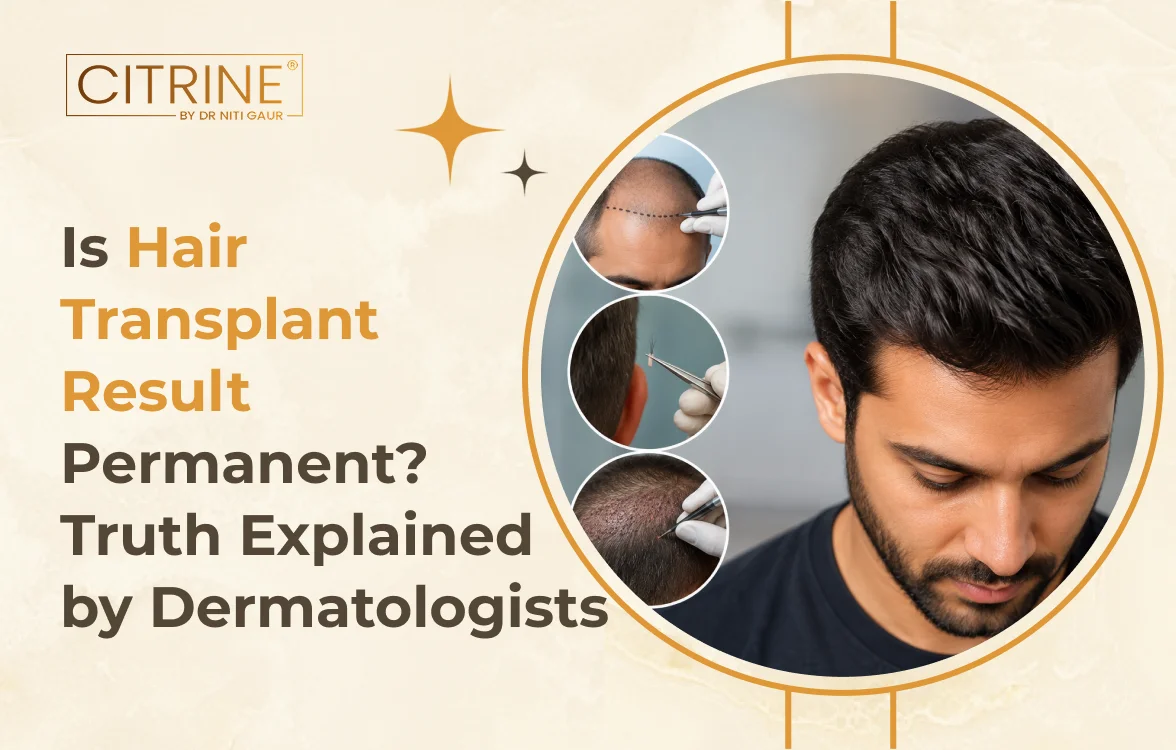
Hair transplant is generally viewed as a long-lasting solution for extensive hair thinning or baldness. It is usually the last resort for men and women who have tried every alternative natural hair restoration treatment. However, most patients who consider a hair transplant often ask this: “Is Hair Transplant Result Permanent?”
The direct answer is yes.
But there is more to know about the hair transplant results and their permanency.
In this article, our dermatologists and trichologist in Gurgaon at Citrine Clinic explain what makes a hair transplant permanent, what factors influence its outcomes, and how to maintain new hair for the long term to help patients be well prepared with realistic expectations before treatment.
Quick Summary About Hair Transplant Results
- New hair growth starts after 3-4 months.
- After 2-8 weeks of hair transplantation, the transplanted hair falls out due to surgical shock.
- Transplanted hair follicles retain genetic resistance to pattern hair loss.
- Visible hair growth takes 6-9 months, and the final results show up in 12-18 months.
- In non-transplanted areas, hair thinning and hair loss can still occur.
- The implanted hair follicles continue to naturally grow healthy, thick hair in the thinning or balding areas following successful transplantation.
- The longevity of the results depends on the surgeon’s expertise and the patient’s age, donor hair quality, hair loss progression, medical management, and lifestyle habits.
How Does a Hair Transplant Work?
Hair transplantation is the surgical hair restoration of the lost natural hair. It involves moving healthy hair follicles from areas unaffected by DHT (dihydrotestosterone) hormone/pattern hair loss- usually the back or sides of the scalp- to the regions affected by hair thinning or baldness.
There are different hair transplant techniques, including:
- Follicular Unit Extraction (FUE)
- Follicular Unit Transplantation (FUT)
- Direct Hair Implantation (DHI).
Each varies based on how the hair follicles are extracted, either by strip method or direct extraction.
Why Are Hair Transplant Results Permanent?
The hair follicles that are chosen for hair transplantation are genetically resistant to DHT- the hormone primarily responsible for pattern hair loss.
Once the carefully selected hair transplants are implanted into the recipient area:
- They build a new blood supply
- They temporarily get into the resting phase of the hair growth cycle
- They grow new hair normally, for many years due to their retained donor dominance.
Does Transplanted Hair Ever Fall Out?
Yes, temporarily, during the initial phase of hair transplant recovery.
The transplanted hair often falls out within the first few weeks following surgery. This is normal, not a sign of hair transplant failure.
Though hair falls out, the roots remain alive underneath the skin, so it gradually resumes normal hair growth.
Why Do Some People Think that Hair Transplants Don’t Last for a Lifetime?
The transplanted hair follicles are permanent, but the hair can fall out initially to grow new hair. Moreover, in patients with genetically induced pattern hair loss, the surrounding native hair may continue to miniaturize and eventually fall out.
All these can lead to an impression of a hair transplant failure:
- No medical management after surgery with topical minoxidil, P-RP, GFC, or LLLT
- Underlying progression of genetic hair loss/androgenetic alopecia
- Poor quality of donor hair
- Unrealistic expectations
- Lack of proper hair transplant planning.
What Factors Influence Long-Term Success of Hair Transplant?
- The expertise of the surgeon in graft harvesting, handling, and implantation as well as hairline designing
- Strict adherence to a proper aftercare plan that supports graft survival and optimal healing
- The quality of donor hair grafts
- Age, whether there is rapid progressive hair loss
- Need for long-term maintenance therapy
- General health and nutrition
- Scalp condition.
Also Read: How to Stop Male Pattern Baldness from Progressing?
Can a Hair Transplant Ever Fail?
Modern hair transplant techniques have a high success rate when performed by experienced hair restoration surgeons with proper planning and careful patient selection.
Less-than-ideal outcomes and more risks are generally due to:
- Poor hair transplant technique
- Poor survival of hair grafts
- Insufficient healthy donor hair
- Infection of the transplant sites
- Habit of smoking or alcohol consumption
- Poor adherence to surgeon’s post-operative instructions
- Setting of unrealistic expectations
- Missing all follow-ups.
How to Maximize the Long-Term Results of Hair Transplant?
- Go for maintenance hair therapies like hair growth medications, PR-P/GFC injections, or LLLT
- Attend all scheduled visits to the surgeon and manage ongoing hair loss
- Protect the donor and recipient areas from excessive UV exposure and other harms
- Follow the recommended aftercare plan
- Maintain a well-balanced, hair-healthy diet
- Manage stress with yoga and meditation
- Take adequate rest at night
- Avoid smoking and alcohol intake.
Who Can Get a Permanent Hair Transplant?
Suitable candidates are healthy men and women with:
- Stable pattern hair loss
- Sufficient donor hair availability
- Realistic expectations
- Commitment to a long-term maintenance plan.
A detailed, personalized consultation is essential to determine whether a hair transplant is a worthy investment for an individual.
Final Takeaway
A successful hair transplant is not just about the approach; it is about proper diagnosis, competent hairline planning, healthy graft survival, and long-term hair supervision.
At Citrine Clinic, experienced hair transplant surgeons in Gurgaon and dermatologists carefully assess the pattern of hair loss, donor hair quality, scalp condition, and future hair loss progression before recommending treatment.
Many patients have achieved natural-looking hairlines, improved density, and long-lasting results with personalized treatment planning and consistent follow-up care.
If you are considering a hair transplant, understanding whether you are a suitable candidate and what results you can realistically expect is an essential first step. You can connect with our dermatologist to explore the treatment approach that best matches your hair restoration goals and long-term expectations.
View Citrine clinic location, directions, and reviews on Google Maps
FAQs About Hair Transplant Results
Will I need another hair transplant in the future?
Possible, if there is extensive, ongoing hair loss. If an additional procedure is considered after a hair transplant, the hair transplant outcomes can last longer.
Can a hair transplant stop further hair loss?
No. A hair transplant restores hair only in the stable, hair-thinning and hair loss areas. In patients with genetic hair loss, the non-transplanted hair continues to miniaturize and eventually fall out.
Is hair transplant successful for everyone?
Yes, if the patient has enough good-quality donor hair, good health, stable hair thinning/hair loss, proper pre- and post-operative care, and a suitable hair transplant technique. Proper evaluation is essential before the surgery to confirm suitability.
Can transplanted hair be cut, styled, or coloured?
Yes. Once the transplanted hair has fully grown, it behaves like natural hair. One can cut, style, wash, and color it as usual. However, one must follow a dermatologist's advice and wait until the scalp has completely healed before using hair dyes or chemical treatments.
About the Author