
 21 Jul 2026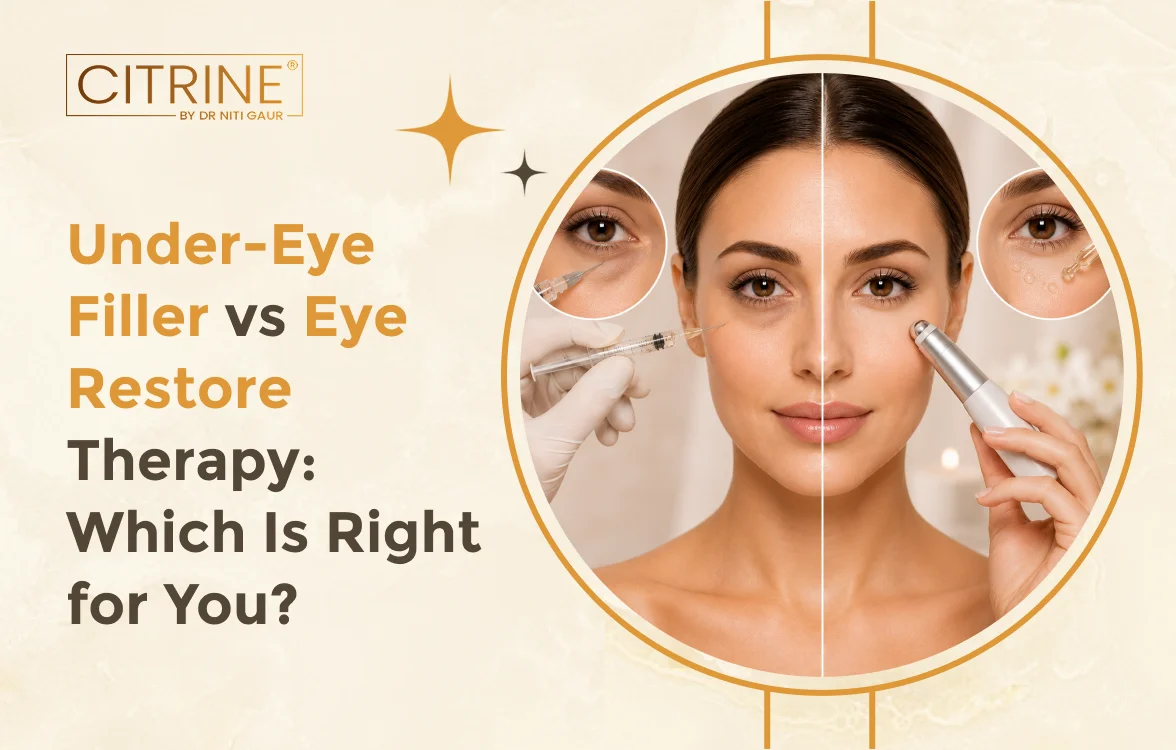
Dark circles do not always mean you need filler.
Some people have a tear trough that creates a shadow. Others have pigmentation, thin skin, dehydration, puffiness, fine lines, or several concerns.
Under-eye filler restores volume. Eye Restore Therapy focuses on pigmentation, hydration, texture, and early aging.
Neither is automatically better. The right choice depends on the cause.
Quick summary
- Under-eye filler is better suited to hollowness and tear trough shadows.
- Eye Restore Therapy may suit pigmentation, dryness, dullness, and fine lines.
- Filler does not remove brown pigment.
- Eye Restore Therapy cannot replace major volume loss.
- Large eye bags may require another approach.
- Some patients may benefit from a combination.
Why do your under-eyes look dark or tired?
Dark circles are not one condition.
Structural hollowness
A tear trough is a groove between the lower eyelid and cheek. It creates a shadow that looks darker in certain lighting.
Pigmentation
Brown or grey-brown colour can be linked to genetics, sun exposure, inflammation, or repeated rubbing.
Thin or vascular skin
Delicate under-eye skin may allow blue, purple, or reddish blood vessels to show through.
Puffiness and eye bags
Bulging fat pads or fluid retention create fullness. The shadow below the swelling may look like a dark circle.
Texture and dehydration
Dryness, crepey skin, and fine lines can make the area look tired even without deep hollowness. Many patients have a mixed pattern, so one treatment may improve only part of the concern.
What is under-eye filler?
Under-eye filler, also called tear trough filler, is an injectable treatment used to soften hollows beneath the eyes.
Most treatments use hyaluronic acid gel. The product is placed carefully to support the transition between the lower eyelid and cheek. The goal is to reduce the hollow and soften its shadow, not make the area completely flat.
Results may appear quickly, but swelling can affect the early appearance.
What can under-eye filler improve?
It may help with a visible tear trough, mild to moderate hollowness, shadow-related dark circles, and an uneven transition between the lower eyelid and cheek. It works best when the concern is structural and there is little baseline puffiness.
What under-eye filler cannot fix
Filler does not directly treat:
- Brown pigmentation
- Sun damage
- Thin or crepey skin
- Large eye bags
- Significant skin laxity
- Allergy-related dark circles
- Active eczema or irritation
The shadow may improve while the pigmentation remains visible.
Also Read: I Sleep 8 Hours Still Have Dark Circles – What's Wrong?
What is Eye Restore Therapy?
Eye Restore Therapy is a customised under-eye rejuvenation protocol used at Citrine Clinic. It is not one fixed procedure. Depending on the concern, the plan may include cleansing, exfoliation, a periocular peel, laser toning, serum infusion, or hydration.
It improves skin quality rather than adding volume. Ask what each step should improve.
What can Eye Restore Therapy improve?
It may be considered for pigmentation, dull or dehydrated skin, mild puffiness, early fine lines, uneven texture, and mild crepiness.
Results are gradual. Hydration may improve earlier, while pigmentation and texture often need several sessions.
What Eye Restore Therapy cannot reliably fix?
Eye Restore Therapy cannot replace significant lost volume.
If the tear trough is deep, improving pigmentation and hydration may freshen the skin, but the hollow may remain.
It may also have limited benefit for:
- Large eye bags
- Significant loose skin
- Advanced volume loss
- Medical swelling
- Deep genetic hollows
These concerns may require another treatment.
Under-eye filler vs Eye Restore Therapy
| Comparison Point | Under-eye Filler | Eye Restore Therapy |
| Main purpose | Replaces volume | Improves skin quality |
| Best for | Tear troughs and shadow | Pigmentation, dryness, dullness, mild lines |
| Treatment type | Injectable | Customised non-surgical protocol |
| Speed | Structural change may appear quickly | Improvement is gradual |
| Sessions | Often one session plus review | Usually a course |
| Downtime | Bruising, swelling, tenderness | Redness, dryness, sensitivity |
| Pigmentation | Limited benefit | May help selected pigment concerns |
| Deep hollows | More direct | Limited |
| Large eye bags | May make them worse | Usually limited |
| Main drawback | Overfilling and injection risks | Irritation and variable response |
Who may be a good candidate for under-eye filler?
Filler may suit you if:
- A clear hollow is the main concern.
- The darkness is mainly caused by shadow.
- There is little baseline puffiness.
- The lower eyelid has reasonable support.
- Your expectations are realistic.
- You accept temporary results and maintenance.
Candidate selection is essential. Conservative treatment can look natural, while unsuitable placement can look heavy or swollen.
Who may not be suitable for filler?
Filler may not be the best first choice if you have:
- Prominent eye bags
- Persistent morning swelling
- Malar oedema
- Loose lower-eyelid skin
- Active infection or eczema
- Previous poor filler results
- Darkness caused mainly by pigmentation
Who may benefit from Eye Restore Therapy?
Eye restore therapy may be worth discussing when the main concerns are pigmentation, dryness, dullness, mild texture changes, early fine lines, or a preference to avoid injectable volume.
However, peels and lasers must be selected carefully, especially in deeper skin tones. Aggressive treatment can trigger irritation or post-inflammatory pigmentation.
Which treatment gives faster results?
Under-eye filler usually produces the faster structural change, although swelling can temporarily affect the early result. Eye restore therapy works more gradually.
Hydration may improve early, but pigmentation and texture often need several weeks and multiple sessions. Faster does not mean better. The wrong treatment may fail or create an unnatural result.
How long can results last?
Filler gradually breaks down, and its longevity varies with the product, amount, anatomy, and metabolism.
Eye restore therapy results depend on the procedures used. Pigmentation or dryness can return with sun exposure, allergies, rubbing, or inconsistent skincare.
Neither option permanently stops aging, so maintenance may be needed.
What are the risks of under-eye filler?
Common side effects include bruising, swelling, tenderness, redness, temporary asymmetry, and small lumps.
Other problems may include prolonged puffiness, visible product, migration, contour irregularities etc.
Rarely, filler can block or compress a blood vessel, causing tissue injury or visual complications.
What are the risks of Eye Restore Therapy?
The risks depend on the procedures used.
Possible effects include redness, mild swelling, dryness, sensitivity, irritation, flaking, temporary darkening, and post-inflammatory pigmentation. Results may be subtle when deep hollows or large eye bags are the main concern.
Ask whether the session includes a peel, laser, exfoliation device, or serum infusion because the risks differ.
Can both treatments be combined?
Yes, but not everyone needs both.
A patient may have a tear trough with pigmentation or crepey skin. The doctor may then recommend a staged plan.
Skin quality may be treated first, followed by conservative filler after the remaining shadow is reassessed. The order depends on anatomy, sensitivity, and recovery needs.
How should you choose?
| Main Concern | Option More Likely to Be Discussed |
| Deep tear trough | Under-eye filler |
| Shadow that changes with lighting | Under-eye filler |
| Brown pigmentation | Eye Restore Therapy or another pigment plan |
| Dry, dull skin | Eye Restore Therapy |
| Early fine lines | Eye Restore Therapy or another skin treatment |
| Large eye bags | Neither may be ideal |
| Loose lower-eyelid skin | Tightening or surgical assessment |
| Hollow plus pigmentation | Staged combination |
| Persistent swelling | Medical assessment first |
A face-to-face examination is still necessary because photographs may hide fluid retention, laxity, vascular colour, or the true depth of a hollow.
Common mistakes to avoid
Treating every dark circle with filler
Filler only helps when volume loss or shadow is an important part of the problem.
Ignoring existing eye bags
Adding volume beneath a puffy lower eyelid may make the area look heavier.
Expecting a peel or laser to fill a hollow
Skin treatments can improve brightness and texture, but they cannot replace missing volume.
Asking for too much filler
The under-eye usually needs a conservative approach. Overcorrection can create puffiness or an unnatural contour.
Expecting permanent removal
Genetics, ageing, allergies, rubbing, and sun exposure can continue to affect the area.
Choosing only by price
A cheaper treatment is of poor value when it does not match the cause.
Not asking what eye restore therapy includes
Results and risks depend on the exact peel, laser, device, and products used.
Questions to ask during your consultation
Before filler, ask:
- What is causing my dark circles?
- Do I have puffiness or malar oedema?
- Which filler and quantity are planned?
- Is hyaluronidase available?
- What result is unlikely to improve?
Before Eye Restore Therapy, ask:
- Which procedures are included?
- Are the peel or laser settings suitable for my skin tone?
- How many sessions may be needed?
- What downtime should I expect?
- Can pigmentation temporarily worsen?
- Will the treatment improve my hollow?
Final takeaway
Under-eye filler and eye restore therapy are not interchangeable. Choose filler when a genuine tear trough or volume deficit creates the tired appearance.
Consider eye restore therapy when pigmentation, dullness, dehydration, mild puffiness, fine lines, or uneven texture is the main concern.
Do not choose filler simply because the area looks dark. Do not expect a skin treatment to replace major volume loss.
Some patients need a combination. Others need neither. A responsible consultation may recommend no procedure when the likely benefit is small or the risk of puffiness, irritation, or an unnatural result is high.
Dr. Niti Gaur, an MD dermatologist associated with Citrine Clinic in Gurgaon, follows an assessment-led approach to identify the causes of under-eye concerns before planning treatment.
Patients considering under-eye filler or eye restore therapy can consult Dr. Niti Gaur at Citrine Clinic to understand which option, combination, or alternative is most appropriate.
Check our Google Maps listing for directions and genuine patient feedback.
Frequently asked questions
1. Is under-eye filler good for dark circles?
It may help when the darkness comes mainly from a tear trough shadow. It will not directly remove brown pigmentation.
2. Can under-eye filler make eye bags worse?
Yes. Filler adds volume and may attract water, making existing puffiness more noticeable.
3. Does eye restore therapy fill hollows?
No. It may improve brightness and skin quality, but it cannot reliably replace significant volume loss.
4. Can tear trough filler be dissolved?
Hyaluronic acid filler can often be reduced with hyaluronidase. This is still a medical procedure.
5. How many eye restore therapy sessions are needed?
There is no fixed number. It depends on the cause, skin sensitivity, and treatments included.
6. Which is better for genetic dark circles?
It depends on whether the inherited feature is pigmentation, thin skin, hollowness, or a combination.
7. Can I get filler if I have puffy eyes?
Possibly, but significant puffiness often makes filler a poor choice. Medical assessment is important.
8. Are the results permanent?
No. Filler gradually breaks down, while skin improvements may need maintenance and sun protection.
About the Author