

 26 Aug 2026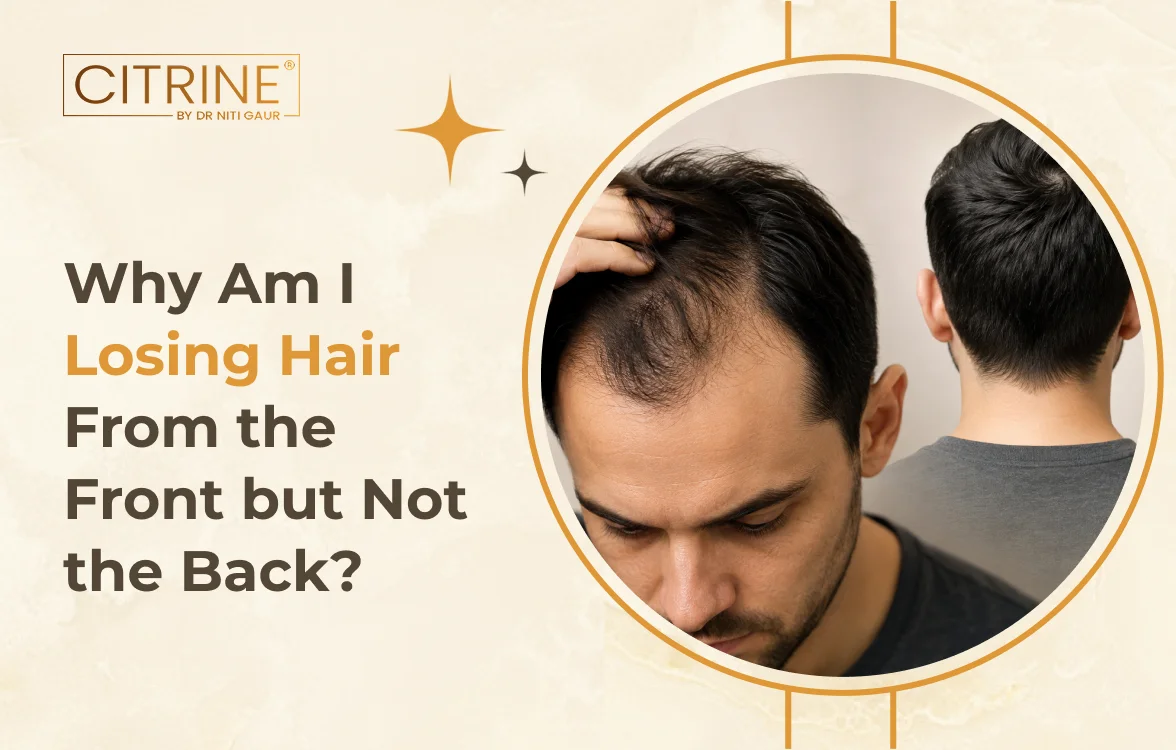
Visible hair thinning or hair loss from the front of the scalp while the back of the head remains thick and dense can be confusing and deeply unsettling. Most people experience a receding hairline, thinning at the temples, or widening frontal parting while the back of their head remains fully covered with hair. This is usually the characteristic sign of pattern hair loss (androgenetic alopecia).
Wondering why?
This can be due to differences in hair follicles, shares Dr. Niti Gaur, MD, dermatologist in Gurgaon and founder of leading dermatology clinic, Citrine Clinic. The hair follicles at the back and sides of the head are genetically resistant to hair loss, specifically the DHT (dihydrotesto-sterone) hormone responsible for hair loss. At the same time, the frontal and crown regions are more sensitive to DHT.
However, genetics is not the only reason for frontal hair loss. Other possible causes include long-term hair pulling or tension at the hair roots, inflammatory scalp conditions, nutritional deficiencies, hormonal changes, or certain forms of scarring alopecia. Understanding the cause of frontal hair loss can help you start early treatment to prevent existing hair from falling out.
Quick Summary About Frontal Hair Loss
- Main cause: Genetic DHT sensitivity
- Other causes: Traction, inflammation, nutritional or medical factors
- Treatments: Medications, minoxidil, correction of deficiencies, hair restoration, or transplant
- Why see a dermatologist: To identify the cause and choose the right treatment.
Why Hair Loss is Usually in the Front, Not at the Back of the Head?
Hair follicles are not identical across the entire scalp, and so their response to hormonal changes and genetic signals varies.
Individuals who are genetically susceptible to hair loss may experience gradual miniaturization of hair follicles at the:
- Frontal hairline
- Temples
- Mid-scalp
- Crown.
With the shrinkage of their hair follicles, their hair strands become thinner, finer, shorter, and less pigmented. As a result, scalp hair coverage becomes less noticeable.
This natural process of hair follicle miniaturization is not seen on the back of the scalp or even the sides because the hair follicles there are more resistant. In pattern hair loss, the back and sides of the scalp are resistant to DHT, which shortens the active growth phase and leads to progressive miniaturization. Because the back hair follicles retain this resistance, they are chosen for hair transplant grafts.
Potential Causes of Hair Loss at the Front
- Genetics and Hormones
Frontal hair loss is mostly due to androgenetic alopecia- the pattern of hair loss. It results from progressive shrinkage of hair follicles driven by genetics and increased sensitivity to the DHT hormone.
In men, it shows up as receding temples, an M-shaped hairline, and frontal and crown thinning. In women, it shows up as diffuse frontal or central scalp hair thinning, a widening of the hair part, or reduced density at the top of the scalp.
- Traction Alopecia
It is the gradual hair loss resulting from repeated pulling/tension on the hair roots. Early cases may improve with relieving of tension. But if it's ongoing, over time there is permanent scarring or death of the hair follicles, eventually leading to hair loss.
- Frontal Fibrosing Alopecia
This is a rare type of scarring hair loss that can lead to gradual recession of the hairline along the front and sides of the scalp and even cause eyebrow hair loss with mild inflammation.
- Telogen Effluvium
Excessive stress, an underlying illness, shock from major surgery, nutritional deficiency, and other physical triggers can cause a temporary shift of many hair follicles into the shedding phase. This can lead to diffuse, noticeable hair thinning around the front of the scalp.
- Scalp inflammation
Frontal hair density can also decrease due to an inflammatory scalp condition that causes follicular damage.
How Can a Dermatologist Help Identify the Cause of Front Hair Loss?
During consultation with a dermatologist, the following is evaluated:
- Hair loss pattern
- Rate and duration of the hair loss
- Personal and family medical history
- Haircare routine/styling
- Current intake of medications
- General and scalp health status.
A dermatologist performs a careful scalp examination to look for signs of inflammation, miniaturized hair follicles, scaling, and scarring. In some cases, dermoscopy or trichoscopy is performed to identify changes in hair shaft thickness and hair follicle health. If hormonal, nutritional, or other medical factors are suspected, a blood test is recommended.
How does a Dermatologist treat Front Hair Loss?
A dermatologist recommends treatment based on the cause and severity of hair loss, as well as the patient’s age, gender, and medical history.
Here are the usually recommended one or more of the following:
- Medical treatment: Topical minoxidil and other prescription drugs, whichever is appropriate for pattern hair loss.
- Prescription supplements: If blood tests confirm a nutrient deficiency, the dermatologist recommends supplements to correct and normalize the hair growth cycle.
- Treatments that soothe inflammation: For traction alopecia and frontal fibrosing hair loss, the dermatologist recommends treatments that calm inflammation and protect the remaining hair follicles.
- Hair restoration: A hair transplant is recommended for permanent, stable front hair loss when there is enough healthy hair at the back of the head. The surgery involves moving hair follicles from the back or sides of the head into thinning or hair-loss-affected areas on the front of the head.
- For younger patients with progressive hair loss, long-term treatment planning is a must with the help of a dermatologist.
How to Protect Remaining Front Hair?
Protect your existing front hair by:
- Seeking an early evaluation and treatment by a dermatologist
- Avoiding tight hairstyles and chemical/heat-based hair treatments
- Managing scalp inflammation
- Improving scalp health
- Getting nutrient deficiency corrected (if detected).
Read Also: Best Hair Loss Treatment Based on Your Age (20s, 30s, 40s)
Final Takeaway
Losing hair from the front, but not the back, is often due to genetics and hormonal sensitivity in hair follicles. This is also why the back of the head is the best place to harvest grafts for a hair transplant. However, front hair loss can even result from scarring, hair pulling, scalp inflammation, or other medical factors.
Early diagnosis and treatment with a dermatologist are highly recommended, rather than waiting for extensive miniaturization of hair follicles and significant hair loss. This way, existing hair can be preserved and, where possible, lost hair can be restored.
If you're noticing hair loss mainly from the front, don’t wait for it to progress. Consult an experienced hair loss treatment doctor in Gurgaon, Dr. Niti Gaur at Citrine Clinic to identify the underlying cause and discuss suitable treatment options. Early evaluation can help preserve existing hair and determine whether medical treatment or hair restoration is appropriate. Schedule a consultation for details!
Locate Citrine Clinic easily and explore verified patient experiences.
FAQs on Frontal Hair Loss
Why am I losing hair from the front but not the back?
Probably because of pattern hair loss, where the hair follicles at the front are genetically more sensitive to DHT hormone-induced hair loss. There could be other reasons. Identify your cause by seeking a dermatologist evaluation.
Can lost front hair grow back?
Maybe, depending on the cause. Early hair loss, when hair follicles are still active, can respond better to treatment. But long-standing, scarring hair loss may cause permanent hair follicle destruction, so hair can only grow there with a hair transplant.
Why is the back of the head used as a donor site for hair transplant?
The hair follicles at the back of the scalp are genetically resistant to the hormonal effects of hair loss. Because they retain this genetic resistance, they can be used as hair grafts for transplantation in some patients.
Can minoxidil help grow back lost front hair?
Yes, in some cases, including androgenetic alopecia, if a dermatologist prescribes it.
When should I see a dermatologist for front hair loss?
See a dermatologist if the front hair loss is rapid or progressing, accompanied by itching or inflammation, involves loss of eyebrow hair, or the cause is still unclear.
About the Author