

 26 Sep 2026
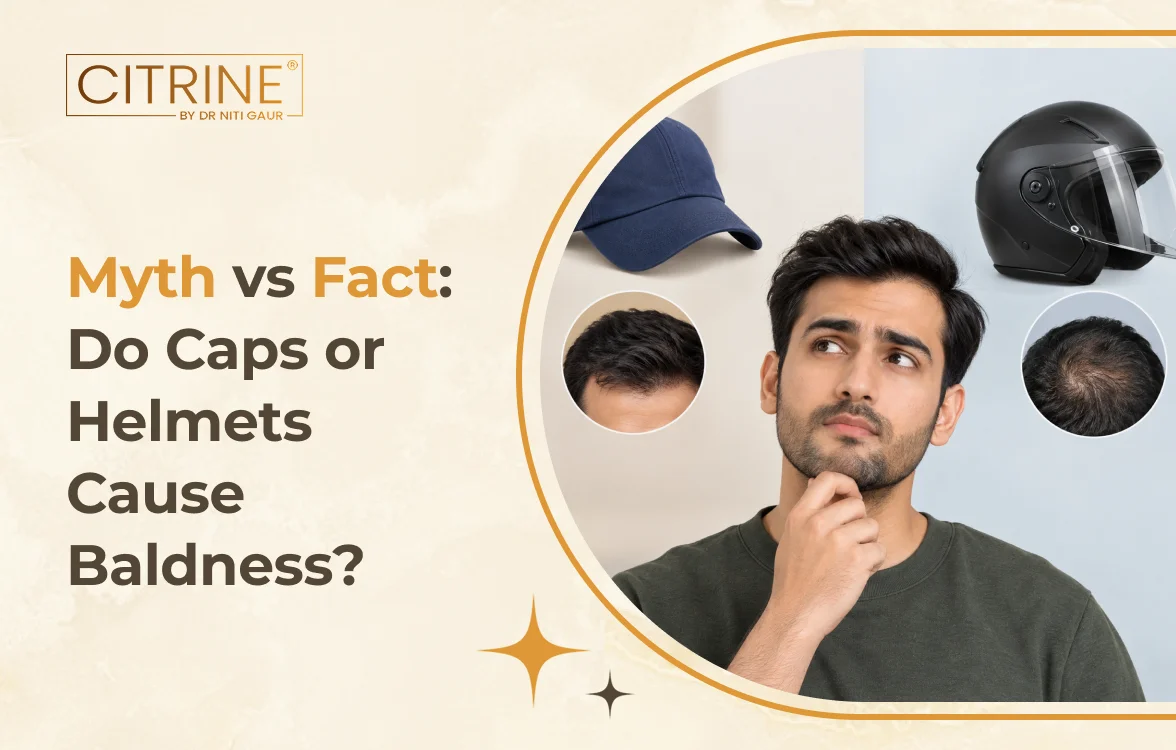
A cap, helmet, or any headgear that is worn daily for long hours can make the scalp sweaty, itchy, or uncomfortable. If that is in your routine, you would ask:
Can everyday wear of caps or helmets cause hair loss or baldness?
This is one of the most asked questions to our clinic’s experts. The worry is so constant that it can feel like a real possibility. But the upcoming expert, definitive answer can dissolve your fear.
Wearing a tailor-made cap or a properly fitted helmet does not cause pattern baldness. Pattern baldness is primarily due to genetic predisposition, age, hormonal factors, and hair follicles' sensitivity to DH-T hormones, shares Dr. Niti Gaur, dermatologist and hair fall doctor in Gurgaon, at Citrine Clinic.
However, if you have poor scalp hygiene or experience excessive friction and prolonged pressure from wearing a very tight head covering, your scalp may get extremely irritated to a level that hair follicles get damaged, and you temporarily lose some hair.
In this article, our clinic’s expert separates myth from fact, explains the real possibilities of hair issues under your head covering, and details what you can do to avoid head-covering-related hair loss.
Quick Summary
- Wearing caps or helmets does not directly cause permanent baldness.
- The real reason for permanent, pattern baldness is genetics and hormones.
- Minor exceptions are traction alopecia (temporary hair breakage or pulling) and poor scalp hygiene.
- The solution is to wear a properly fitted head covering and keep the scalp clean.
Popular Myths Debunked
Myth 1: Wearing a Cap or Helmet Daily Causes Permanent Baldness
Fact: There is no evidence that normal wearing of a properly fitted cap or helmet causes permanent baldness or pattern hair loss. Permanent baldness can be caused by genetics, age, and high sensitivity to D-HT hormones, which permanently and progressively miniaturize hair follicles, causing the hair they produce to become thinner, finer, and shorter until the follicles stop normal hair growth.
Myth 2: Hair Strands Spotted Inside Your Cap or Helmet Indicates You Are Getting Bald
Fact: Hair can shed daily, so fallen hair can get trapped inside your cap or helmet. Normal shedding is when it doesn't go beyond 50-100 a day. So if you see loose hair when you take off your cap or helmet, it doesn't necessarily mean permanent hair loss.
Myth 3: Wearing Caps or Helmets Suffocates Your Hair
Fact: Hair follicles don’t breathe. They don’t require outside air to grow; instead, they rely on blood-dissolved oxygen and nutrients. They get oxygen and the required nutrition directly from the internal blood supply through the deep network of blood vessels across the scalp. Even a slight pressure or vacuum created by wearing a cap or helmet cannot stop the scalp’s microcirculation and oxygen/nutrients supply to the hair follicles.
Myth 4: Tight Caps or Helmets Could Cut Off Scalp’s Microcirculation
Fact: A tight-fitting cap or helmet does not restrict the flow of blood to the hair follicles to a level that it could damage the hair follicles or cause baldness. However, if the fit is very tight and it is worn for a long time, persistent friction, pressure, and hair pulling in the same area can occur. This could lead to temporary hair breakage or hair loss (traction alopecia). Early hair pulling beneath the head covering may be reversible if you replace the cap or helmet and style your hair loosely. But prolonged hair pulling can cause irreversible hair follicle damage and baldness.
Myth 5: Caps or Helmets Block the Sunlight, but Hair Needs Sun Exposure to Grow Healthy
Fact: Vitamin D produced by the body from sunlight exposure is important for overall hair health. But the sun’s UV rays do not feed the scalp and hair. Instead, direct, prolonged sunlight damages the hair shaft, making hair dry, brittle, and more likely to break. So, a cap or helmet protects the scalp and hair from UV damage. Noticeable, permanent hair loss is an internal biological process, not something caused by a head covering alone.
Myth 6: Sweat Trapped in Cap or Helmet Causes Baldness
Fact: Wearing an unwashed cap or unclean helmet can affect scalp hygiene. Sweat, heat, dirt, excess sebum, and some hair product residue can get trapped in the hair follicles, irritating the scalp, causing flakiness, or leading to mild infection/inflammation and increased hair shedding. This won’t lead to baldness, so headwear shouldn't be blamed. In genetically susceptible people, baldness can occur regardless of scalp hygiene.
Myth 7: Avoiding Everyday Wearing of Cap or Helmet Can Stop Baldness
Fact: Baldness will happen if it's hereditary or hormonal. Safety headwear has no connection to baldness, so you shouldn't avoid it out of fear of hair loss.
How to Know if Hair Loss is the Start of Genetic Baldness or Cap/Helmet Related?
Conclude hair loss as genetic if you see:
- A well-defined, typical pattern of hair loss
- A mix of thick, normal hair and fine, light, short hair
- More visible scalp without physical sensation
- Gradual, progressive hair loss over months to years.
You can relax; it’s just temporary hair loss caused by head covering if you see:
- Localized hair thinning or hair breakage at pressure points
- No visible scalp but scalp itchiness, soreness, redness, or folliculitis
- Quick, noticeable hair fall
- Snapped-off, frizzy, or split ends
- Normal, thick hair growth.
How to Prevent Hair Loss and Damage from Caps or Helmets?.
Don't stop wearing caps or helmets; wear them smartly and maintain scalp hygiene. Our experts provide the following practical tips:
- Create a protective barrier between hair and helmet liner with a thin, satin or silk cap
- Never wear a cap or helmet on wet hair, as it can affect hygiene and cause hair breakage
- Avoid wearing tight buns or high ponytails under a cap or helmet
- Avoid applying excessive, heavy scalp and hair products
- Keep the headwear snug, not tight
- Keep the cap or helmet clean
- Maintain a healthy, clean scalp.
Read Also: How to Stop Male Pattern Baldness from Progressing?
Conclusion
A cap or helmet is not the cause of baldness; rather, genetics, hormones, autoimmune conditions, certain medications, some illnesses, or scalp conditions are. However, hair shedding can increase if a cap or helmet is unclean or extremely tight-fitting.
If you are experiencing persistent hair fall, thinning, or a receding hairline, consult our dermatologist to understand the underlying cause. At Citrine Clinic, our expert dermatologist in Gurgaon can assess your scalp and hair concerns and recommend a treatment plan based on your condition, rather than assuming that caps or helmets are responsible for hair loss. Schedule a visit for details!
Locate Citrine Clinic easily and explore verified patient experiences.
FAQs on Caps and Helmets Causing Hair Loss
Does everyday wearing of a cap cause baldness?
No. Permanent hair loss is not possible with a properly fitted, clean cap.
Does wearing a cap or helmet for long hours cause hair loss?
Routine use of a tight or unclean helmet or cap may cause hair breakage and increased shedding, but
generally not permanent hair loss.
Does sweat under a cap or helmet cause hair loss?
Sweat alone cannot cause baldness. But it, along with dirt, sebum, and hair product residue, can irritate the scalp and make it more susceptible to hair loss.
Can a cap or helmet make the hairline recede?
No, hairline recession is generally genetic and hormonal, not due to any head covering.
Can stopping wearing a cap or helmet help prevent hair loss?
No, it can still happen if the underlying cause is genetic, hormonal, medication, illness, a nutrient deficiency, or a scalp condition.
About the Author