

 30 Jun 2026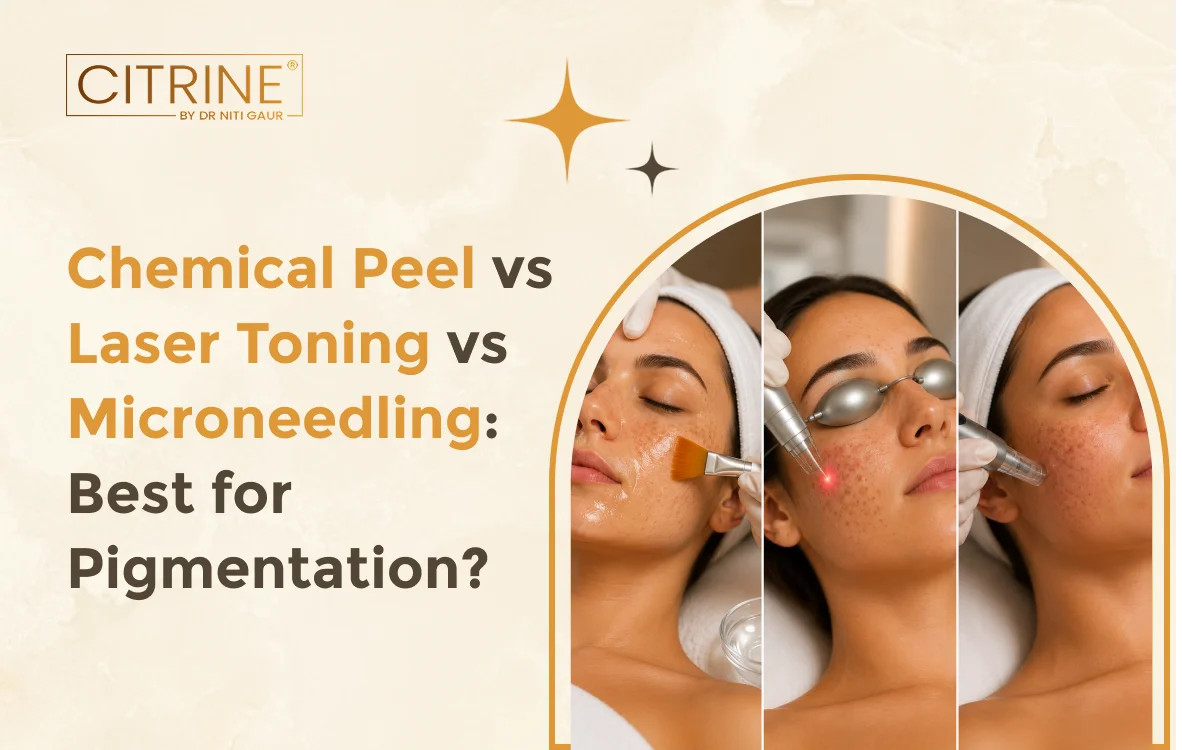
Pigmentation is one of the most common skin concerns seen in dermatology clinics. Whether it appears as acne marks, melasma, sunspots, or uneven skin tone, many people struggle to decide which treatment can actually help.
Three of the most frequently recommended procedures for pigmentation are chemical peels, laser toning, and microneedling. While all three can improve discoloration, they work in different ways and are suitable for different skin types and causes of pigmentation.
The right treatment depends on factors such as the type of pigmentation, your skin tone, sensitivity, downtime preferences, and whether the pigmentation tends to recur.
Quick Summary
- Chemical peels exfoliate the skin and work well for superficial pigmentation and post-acne marks.
- Laser toning targets excess melanin and is often used for melasma and deeper pigmentation.
- Microneedling stimulates collagen and helps with acne scars and certain types of post-inflammatory pigmentation.
- No single treatment is best for everyone.
- Combination treatments often provide better results than a single procedure.
- Proper diagnosis is essential because treating the wrong type of pigmentation can worsen it.
- Consistent sunscreen use remains the most important step in preventing recurrence.
Understanding Pigmentation
Pigmentation occurs when the skin produces excess melanin, the pigment responsible for skin colour.
Common types include:
- Melasma: Brown or grey patches, usually on the cheeks and forehead.
- Post-inflammatory hyperpigmentation (PIH): Dark spots left after acne, rashes, or injuries.
- Sunspots: Pigmentation caused by years of sun exposure.
- Freckles: Small pigmented spots that become darker with sun exposure.
The cause of pigmentation plays a major role in determining which treatment may work best.
Pigmentation Treatments: Short Overview
Chemical Peel
- Uses mild acids to exfoliate the skin.
- Removes damaged pigmented cells.
- Improves skin texture and brightness.
- Usually requires multiple sessions.
Laser Toning
- Uses low-energy laser beams to break down excess pigment.
- Targets deeper pigmentation.
- Minimal downtime.
- Often recommended for melasma.
Microneedling
- Uses tiny needles to create controlled micro-injuries.
- Stimulates collagen production.
- Helps improve acne scars and post-inflammatory pigmentation.
- Can be combined with serums or PRP.
Chemical Peel vs Laser Toning vs Microneedling: Comparison Table
| Feature | Chemical Peel | Laser Toning | Microneedling |
| How it works | Exfoliates outer skin layers | Breaks down melanin using laser energy | Stimulates collagen through micro-injuries |
| Best for | Acne marks, mild pigmentation, dull skin | Melasma, sunspots, deeper pigmentation | Acne scars with pigmentation |
| Downtime | Mild peeling for a few days | Minimal | 1 to 3 days of redness |
| Sessions needed | 4 to 6 | 6 to 10 | 3 to 6 |
| Suitable for darker skin | Yes, with caution | Yes, when performed carefully | Usually yes |
| Improves skin texture | Good | Mild | Excellent |
| Helps acne scars | Limited | Minimal | Very good |
| Risk of rebound pigmentation | Low to moderate | Possible if overtreated | Low |
Which Treatment Is Best for Different Types of Pigmentation?
Best for Post-Acne Marks
Usually: Chemical peels or microneedling
Acne often leaves behind dark spots known as post-inflammatory hyperpigmentation.
Chemical peels help by:
- Removing pigmented surface cells
- Brightening the complexion
- Improving mild acne scars
Microneedling may be preferred if:
- Acne scars are present
- Skin texture is uneven
- Pigmentation is deeper.
Best for Melasma
Usually: Laser toning with a combination approach
Melasma is one of the most difficult forms of pigmentation to treat because it tends to recur.
Treatment often includes:
- Laser toning
- Topical medications
- Strict sunscreen use
- Sometimes chemical peels
Many dermatologists now avoid aggressive treatments because excessive heat or irritation can worsen melasma.
Best for Sunspots and Age Spots
Usually: Chemical peels or laser toning
Sun-induced pigmentation generally responds well to both treatments.
Chemical peels may help with:
- Mild sun damage
- Uneven skin tone
- Dullness
Laser toning may be preferred for:
- Deeper spots
- Resistant pigmentation
- Multiple sunspots.
Best for Acne Scars with Pigmentation
Usually: Microneedling
Microneedling works on two concerns simultaneously:
- Pigmentation
- Scar remodeling
This makes it particularly useful for people who have both dark marks and textural changes after acne.
Chemical Peels for Pigmentation
How Do Chemical Peels Work?
Chemical peels use ingredients such as:
- Glycolic acid
- Salicylic acid
- Lactic acid
- Mandelic acid
- TCA in selected cases
These ingredients remove damaged skin cells and encourage fresh cell turnover.
Benefits
- Improves mild to moderate pigmentation
- Brightens the skin
- Reduces acne marks
- Improves overall texture
- Usually affordable
Limitations
- Multiple sessions required
- Results are gradual
- May not work well for deep pigmentation
- Temporary peeling can occur
Who Is an Ideal Candidate?
Chemical peels may be a good option if you have:
- Mild pigmentation
- Post-acne marks
- Uneven skin tone
- Oily skin
- Early signs of sun damage
Laser Toning for Pigmentation
How Does Laser Toning Work?
Laser toning uses low-fluence laser energy to target melanin without significantly damaging surrounding tissue.
The body gradually removes fragmented pigment particles over time.
Benefits
- Suitable for deeper pigmentation
- Minimal downtime
- Can improve skin brightness
- Useful in melasma management
Limitations
- Requires several sessions
- Results vary in melasma
- Over-treatment may worsen pigmentation
- Maintenance sessions may be needed
Who Is an Ideal Candidate?
Laser toning may be a good option if you have:
- Melasma
- Resistant pigmentation
- Sunspots
- Patients wanting minimal downtime
Microneedling for Pigmentation
How Does Microneedling Work?
Tiny needles create controlled injuries in the skin, triggering:
- Collagen production
- Tissue remodeling
- Improved skin texture
Microneedling is especially useful when pigmentation is accompanied by acne scarring.
Benefits
- Improves scars and pigmentation together
- Enhances skin texture
- Minimal downtime
- Suitable for many skin types
Limitations
- Less effective for isolated melasma
- Temporary redness
- Requires multiple sessions
- Results are gradual
Who Is an Ideal Candidate?
Microneedling may be a good option if you have:
- Acne scars with pigmentation
- Enlarged pores
- Uneven texture
- Post-inflammatory pigmentation
Which Treatment Gives Faster Results?
| Concern | Usually Faster Option |
| Mild acne marks | Chemical peels |
| Melasma | Laser toning |
| Acne scars with pigmentation | Microneedling |
| Uneven skin texture | Microneedling |
| Dull skin and tanning | Chemical peels |
However, pigmentation treatment is rarely an overnight process. Most patients notice visible improvement after several sessions and consistent skincare.
Can These Treatments Be Combined?
Yes. In many cases, combination therapy provides better results than a single procedure.
Examples include:
Chemical Peel + Laser Toning
- Melasma
- Mixed pigmentation
Microneedling + Chemical Peel
- Acne marks
- Uneven texture
Microneedling + PRP
- Acne scars
- Skin rejuvenation
Combination plans should always be customized according to the individual's skin type and diagnosis.
Also Read: Rich Peel Advance: What Makes This Chemical Peel Different?
Factors That Help Determine the Right Treatment
A dermatologist may consider:
- Type of pigmentation
- Depth of pigmentation
- Skin tone
- History of melasma
- Presence of acne scars
- Sensitivity of skin
- Lifestyle and downtime preferences
- Previous treatment history
At clinics that regularly manage pigmentary disorders, including practices such as Citrine Clinic, treatment plans are often tailored because the same procedure can produce different outcomes in different patients.
Common Mistakes People Make When Treating Pigmentation
Choosing a Treatment Without Knowing the Diagnosis
Not all dark spots are the same.
Expecting Instant Results
Pigmentation usually improves gradually over several weeks.
Skipping Sunscreen
Sun exposure is one of the biggest reasons pigmentation returns.
Trying Too Many Treatments Together
Over-treatment can irritate the skin and worsen pigmentation.
Following Social Media Trends
Treatments that work for one person may not work for another.
Common Misconceptions
Laser treatment removes pigmentation permanently.
No treatment can guarantee permanent results, especially for melasma.
Chemical peels thin the skin.
When performed appropriately, they do not permanently thin the skin.
Microneedling is only for scars.
It can also help certain types of pigmentation.
One session is enough.
Most pigmentation treatments require multiple sessions.
Realistic Expectations From Pigmentation Treatments
Patients often ask how much improvement they can expect.
Generally:
- Mild pigmentation may improve significantly.
- Melasma often improves but may require maintenance.
- Deep pigmentation takes longer to treat.
- Lifestyle habits strongly influence long-term results.
Pigmentation management should be viewed as a process rather than a one-time procedure.
Expert Insight
According to many dermatologists, including specialists who frequently treat pigmentary disorders such as Dr. Niti Gaur, successful treatment depends more on accurate diagnosis and long-term maintenance than on choosing the strongest procedure.
The most effective approach often combines:
- Appropriate procedures
- Medical skincare
- Sun protection
- Regular follow-up
Final Takeaway
There is no single "best" treatment for pigmentation.
- Chemical peels are excellent for superficial pigmentation and post-acne marks.
- Laser toning may work better for melasma and deeper pigment concerns.
- Microneedling is often ideal when pigmentation occurs alongside acne scars and textural irregularities.
The most important step is getting the correct diagnosis because the wrong treatment can sometimes worsen pigmentation.
If your pigmentation has persisted despite home remedies or over-the-counter products, a consultation with an experienced dermatologist, such as Dr. Niti Gaur at Citrine Clinic, can help determine the most appropriate and personalised treatment approach based on your skin type and pigmentation pattern.
To book a consultation with Dr. Niti Gaur, visit Citrine Clinic now.
Check our clinic location and read genuine patient reviews before your visit.
View Citrine clinic location, directions, and reviews on Google Maps
Frequently Asked Questions
1. Which treatment is best for melasma?
Laser toning may help some cases, but melasma often requires a combination approach including skincare and strict sun protection.
2. Is microneedling better than laser for pigmentation?
Microneedling is usually better when pigmentation occurs along with acne scars and textural concerns.
3. How many sessions are needed for pigmentation?
Most people require 4 to 10 sessions depending on the type and severity of pigmentation.
4. Can pigmentation come back after treatment?
Yes. Pigmentation, especially melasma, can recur due to sun exposure, hormones, and genetics.
5. Are chemical peels safe for sensitive skin?
Certain peels can be used safely under professional supervision and with proper skin assessment.
6. Which treatment has the least downtime?
Laser toning usually involves the least downtime.
7. Is microneedling painful?
No. A numbing cream is usually applied, making the procedure comfortable for most people.
8. Can dark skin undergo laser toning?
Yes, but treatment should be carefully customised to reduce the risk of post-inflammatory pigmentation.
9. How soon can I wear makeup after treatment?
Most patients can resume makeup within one to three days, depending on the procedure.
10. Is sunscreen necessary after pigmentation treatment?
Yes. Daily sunscreen is essential to maintain results and prevent recurrence.
About the Author