Skin does not usually become loose overnight. With age, gradual collagen loss can make the cheeks look less lifted, the jawline less defined, and the skin around the neck and lower face less firm. Ultherapy treatment in Delhi offers a non-surgical way to address this early to moderate laxity by using focused ultrasound energy to stimulate collagen remodelling in the deeper layers of the skin.
At Citrine Clinic, Dr. Niti Gaur first looks at the degree of skin laxity, facial structure, treatment area, and the kind of improvement you want to achieve. The treatment is then planned around these individual factors, with the aim of creating a gradual lifting and tightening effect while preserving the natural character of your face.
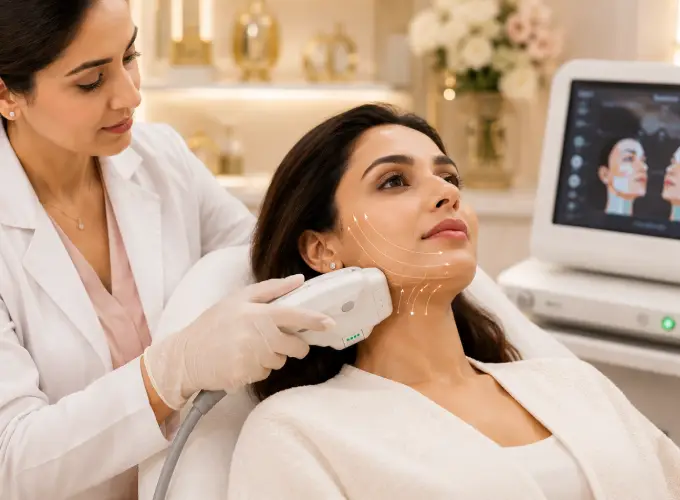

Ultherapy is a non-invasive treatment for skin to improve the firmness of the skin affected by age. It uses focused ultrasound energy to reach deeper layers beneath the skin's surface, where controlled heating triggers the body's collagen-remodelling response. As the skin gradually produces and reorganises collagen, it can become firmer and more supported over time.
One of the main differences with Ultherapy is that it does not rely on removing or resurfacing the outer layer of the skin. Instead, the treatment works beneath the surface, which means there is no need for surgical incisions and the improvement develops gradually rather than appearing immediately.
At Citrine Clinic, Dr. Niti Gaur plans Ultherapy treatment in Delhi after looking at your skin laxity, facial contours, treatment area, and expectations. The energy delivery and treatment plan are then adjusted according to the individual level of laxity and the areas where lifting and tightening are desired.
| Treatment Area | What Ultherapy May Help With |
| Forehead and Brow | Mild skin laxity and early loss of firmness in the upper face |
| Eyebrow Region | Mild laxity and gradual loss of definition around the brow |
| Cheeks | Mild facial sagging and reduced skin firmness |
| Jawline | Reduced jawline definition and mild laxity |
| Chin | Loose or less firm skin around the chin |
| Neck | Reduced firmness and loose skin in the neck |
| Under the Chin | Mild loose skin and laxity beneath the chin |
| Upper Chest (Décolletage) | Signs of ageing and mild skin laxity affecting the upper chest |
The estimated ultherapy treatment cost in Delhi at Citrine Clinic starts from ₹50,000 per session.
The cost of Ultherapy treatment in Delhi may vary depending on:
Ultherapy may offer several advantages for suitable candidates.
Ultherapy is generally considered safe when performed by an experienced dermatologist using appropriate treatment settings.
Temporary effects may include:
Ultherapy treatment in Delhi may be suitable for:
Adults with mild to moderate facial saggingPeople noticing loose skin below the chinIndividuals with early signs of ageingPatients looking for non-surgical skin tighteningMen and women wanting gradual liftingProfessionals seeking minimal downtimePatients with realistic treatment expectationsIndividuals who are not ready for facelift surgeryAn Ultherapy session begins with assessing where the skin has lost firmness and ends with guidance on what to expect after treatment.
Skin and Facial Assessment: The skin, degree of laxity, facial contours, and areas where lifting is desired are evaluated.
Medical History Review: Your medical history and previous aesthetic treatments are discussed to determine whether Ultherapy is appropriate.
Clinical Photographs: Photographs may be taken to document the starting appearance and help assess changes over time.
Skin Preparation: The treatment area is cleansed and prepared before the procedure.
Treatment Zone Marking: The areas to be treated are identified and marked to guide the placement of ultrasound energy.
Application of Ultrasound Gel: A suitable gel is applied to allow the treatment handpiece to move smoothly across the skin.
Ultrasound Imaging: The treatment system is used to assess the tissue and identify the appropriate depth for energy delivery.
Focused Ultrasound Treatment: Controlled ultrasound energy is delivered to the planned areas to create targeted thermal stimulation beneath the skin.
Post-Treatment Assessment: The treated skin is checked once the session is complete, and any immediate skin response is noted.
Aftercare and Follow-Up: You receive guidance on post-treatment care and what to expect as the tightening effect develops gradually over the following months.
Recovery after ultherapy treatment in Delhi is usually straightforward. Most patients return to their daily routine shortly after the procedure.
| Timeframe | What to Expect |
| Immediately After Treatment | Mild redness or slight swelling may be visible. |
| First 24 Hours | Skin may feel mildly tender or tight. |
| 2 to 7 Days | Temporary sensitivity gradually settles. |
| 4 to 8 Weeks | Early collagen stimulation begins. |
| 2 to 6 Months | Skin firmness and lifting gradually become more noticeable. |
Detailed Skin and Facial Assessment: The degree of skin laxity, facial contours, treatment areas, and overall skin condition are assessed before Ultherapy is planned.Treatment Planned Around Facial Anatomy: Ultherapy is not simply applied uniformly across the face. Treatment zones and energy delivery are planned according to individual facial structure and the areas where lifting is desired.Focused Ultrasound Technology: Ultherapy uses focused ultrasound energy to create controlled thermal stimulation beneath the skin, supporting collagen remodelling without surgically removing skin.Personalised Treatment Approach: The treatment plan can be adjusted according to the degree of laxity, areas being treated, and the patient's aesthetic goals.Natural-Looking Lifting: The aim is to encourage gradual tightening and improved definition rather than creating an abrupt or unnatural change in facial appearance.Ultherapy can help tighten mild skin laxity and improve jawline definition when loose skin is contributing to a less defined appearance. It does not remove significant facial fat, so patients with substantial fullness may need a different treatment approach.
A single session may provide noticeable improvement for some patients, while others may require additional treatment depending on the degree of laxity and their individual response. The recommended treatment plan is determined after assessment.
Ultherapy may be combined with other aesthetic treatments, including fillers, when clinically appropriate. The timing and combination should be planned according to the patient's facial structure, skin condition, and treatment goals.
Ultherapy stimulates the body's own collagen-remodelling process rather than creating an immediate lifting effect. As collagen develops and reorganises gradually, the improvement in firmness and definition becomes more noticeable over time.
Yes. Ultherapy may help improve mild skin laxity following weight loss when the skin still has sufficient elasticity. The degree of improvement depends on how much loose skin is present and the overall condition of the skin.
Ultherapy is intended to encourage gradual tightening rather than dramatically alter facial features. The final appearance depends on the treatment plan, degree of laxity, and individual response.
Age alone does not determine suitability. Ultherapy may be considered for older adults with mild to moderate skin laxity, although skin quality, degree of laxity, and overall treatment goals need to be assessed first.
Ultherapy can be repeated or used as a maintenance treatment when appropriate, but there is no fixed schedule that applies to everyone. The timing of any further treatment should be based on ageing changes, treatment response, and clinical assessment.
Ultherapy is better planned well in advance of a major event because the lifting and tightening effect develops gradually as collagen remodels. Your dermatologist can recommend an appropriate timeline based on your treatment goals.