Facial sagging affects everyone differently; some people begin to notice that the cheeks look less lifted, the jawline appears softer, or the skin around the lower face and neck has started to lose its firmness. Threadlift treatment in Delhi at Citrine Clinic offers a minimally invasive approach for mild to moderate skin laxity by encouraging collagen formation over time.
Dr. Niti Gaur evaluates your facial anatomy before recommending a threadlift. The treatment plan is customised according to the areas requiring support and the level of correction suitable for your facial structure. The ultimate goal of the procedure is to achieve a natural-looking improvement.
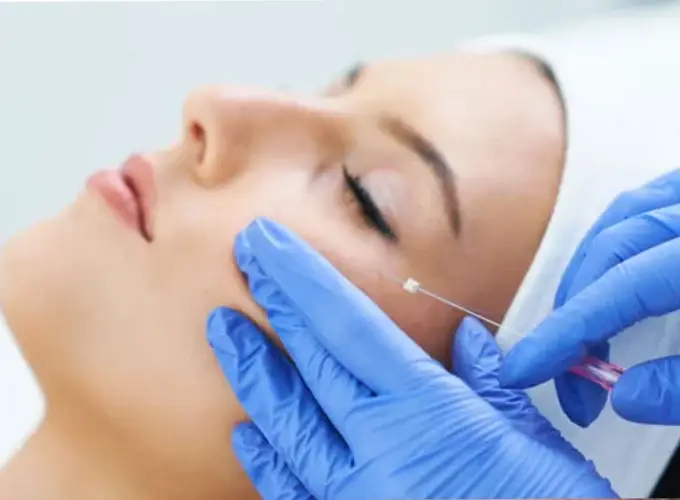

A threadlift is a minimally invasive treatment that improves the appearance of mild to moderate facial sagging. During the treatment, absorbable threads are placed beneath the skin to provide support to the tissues and create a subtle lifting effect. The threads also stimulate collagen production, which gradually improves skin firmness and texture over time.
A threadlift is a non-surgical approach, unlike a surgical facelift, which makes it a viable option for people experiencing early signs of facial ageing and who want a more subtle lift with a shorter recovery period than surgery. At Citrine Clinic, we perform threadlift treatment in Delhi after a detailed assessment of facial proportions, skin quality, degree of laxity, and the areas needing support. Dr. Niti Gaur uses this evaluation to determine whether the thread lift treatment is suitable for the patient.
| Treatment Area | What Thread Lift May Help With |
| Mild Face | Mild sagging and loss of facial support |
| Cheeks | Sagging tissues and reduced cheek definition |
| Jawline | Mild laxity and reduced jawline definition |
| Jowls | Early jowl formation and lower-face sagging |
| Neck | Mild skin laxity and reduced firmness |
| Eyebrows | Mild brow-area laxity and loss of lift |
| Lower Face | Early sagging and reduced facial definition |
| Nasolabial Area | Mild tissue descent and loss of support around the nasolabial region |
| Marionette Lines | Early sagging and reduced support around the lower face |
The estimated thread lift treatment cost in Delhi at Citrine Clinic generally ranges between ₹60,000 and ₹1,20,000 per session.
The cost of a threadlift can vary depending on the extent of lifting required, the type and number of threads used, and the areas being treated.
A thread lift offers both immediate lifting and long-term collagen stimulation for suitable candidates.
When performed by an experienced dermatologist, thread lift treatment is generally safe. Mild temporary effects may occur during the healing phase.
These may include:
Threadlift Treatment in Delhi may be suitable for:
Adults with mild to moderate facial saggingIndividuals noticing early jowl formationPeople with reduced jawline definitionMen and women with loose cheek skinPatients seeking a non-surgical facial liftIndividuals wanting faster recovery than surgeryPatients with mild neck laxityPeople looking for natural-looking facial rejuvenationIndividuals with realistic treatment expectationsA thread lift begins with a detailed assessment and is planned according to the areas requiring support, the degree of laxity, and the patient's facial structure.
Detailed Facial Assessment: Facial proportions, areas of sagging, and the level of lifting required are evaluated.
Medical History Evaluation: Relevant medical history is reviewed to determine whether the procedure is appropriate.
Skin Examination: Skin quality, thickness, and tissue condition are assessed before treatment.
Treatment Planning: The treatment areas, thread type, number of threads, and placement strategy are determined according to the individual anatomy and desired outcome.
Clinical Photographs: Photographs may be taken when required to document the pre-treatment appearance and monitor results.
Treatment Area Cleansing: The selected areas are thoroughly cleansed and prepared for the procedure.
Local Anaesthesia: Local anaesthesia is administered to improve comfort during thread placement.
Precise Thread Placement: The threads are carefully inserted beneath the skin according to the predetermined treatment plan.
Tissue Positioning: The treated tissues are gently repositioned to create the planned lifting effect while maintaining natural facial contours.
Final Skin Assessment: The treated areas are checked after placement to assess the immediate result and overall symmetry.
Post-Treatment Instructions: Aftercare guidance is provided to support healing and minimise unnecessary irritation or pressure on the treated areas.
Follow-Up: A follow-up appointment may be scheduled to assess healing and the developing result.
Recovery after Thread Lift Treatment in Delhi is usually straightforward. Most patients resume light daily activities within one to two days, although minor swelling and bruising may temporarily remain.
| Timeframe | What to Expect |
| Immediately After Treatment | Mild swelling, tightness, or tenderness may be present. |
| First 48 Hours | Slight bruising and pulling sensation can occur. |
| 3 to 7 Days | Swelling gradually settles and comfort improves. |
| 2 to 4 Weeks | Threads begin integrating with surrounding tissues. |
| 2 to 3 Months | Collagen production increases and skin appears firmer. |
| Up to 6 Months | Final lifting and collagen benefits continue to develop. |
Detailed Facial Assessment: Facial structure, skin quality, degree of laxity, and areas requiring support are assessed before the treatment is planned.Personalised Thread Selection: The type and number of threads are selected according to the treatment area, tissue support required, and desired level of lifting.Precise Treatment Planning: Thread placement is planned according to individual facial anatomy to support the tissues while maintaining natural facial proportions.Minimally Invasive Approach: Thread lift provides an option for addressing selected cases of mild to moderate laxity without the larger incisions and extensive recovery associated with surgical lifting.Focus on Natural-Looking Results: Treatment is planned around the patient's existing facial structure, with the aim of creating a subtle improvement rather than an overly lifted appearance.Thread lift results can remain visible for around 12 to 24 months, although longevity varies with skin quality, ageing changes, lifestyle, and the type of treatment performed.
Yes. A thread lift may help reposition tissues contributing to mild jowl formation and improve the definition of the lower face and jawline.
Thread lifts use small entry points rather than large surgical incisions. These entry points generally heal without prominent scarring, although individual healing can vary.
Many patients can return to desk-based work within a few days, depending on the extent of treatment and their recovery. Mild swelling, bruising, or tenderness may remain temporarily.
Yes. A thread lift can be repeated when appropriate, but the timing depends on how the tissues have healed, the remaining degree of laxity, and the individual's treatment goals.
It may be suitable for patients who develop mild facial sagging after weight loss and still have adequate skin elasticity. The degree of loose skin should be assessed before treatment.
The aim of a thread lift is to create a subtle lift and improve facial definition while maintaining natural facial proportions. The final result depends on appropriate treatment planning and thread placement.
Combination treatments may be considered in selected patients. Fillers, Botox, or other procedures address different concerns, so the combination and timing should be planned according to the individual's facial structure and treatment goals.
Makeup is generally avoided around the treated entry points until they have settled. Your dermatologist can advise when it is appropriate to resume makeup based on your healing and the areas treated.
Patients with certain active skin conditions, infections, medical concerns, or a degree of skin laxity that is unlikely to respond adequately to a thread lift may not be suitable candidates. A clinical assessment is necessary before treatment.