

 18 Aug 2026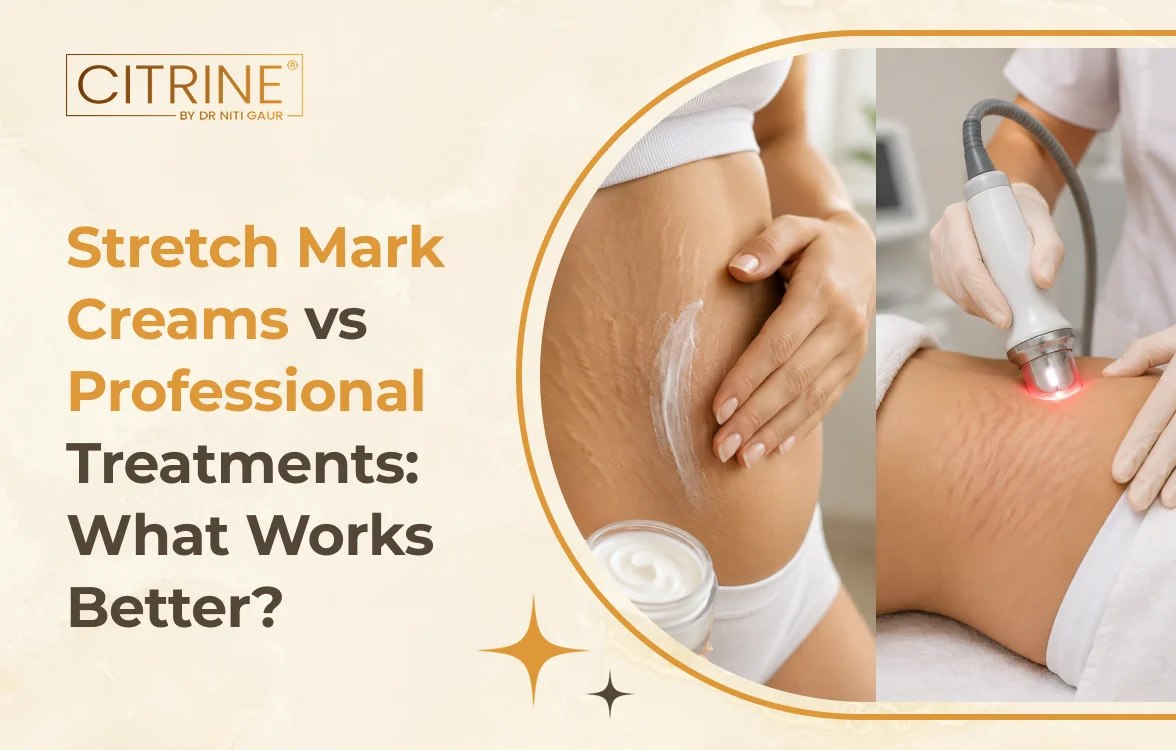
Stretch marks (striae) are a type of scar most commonly seen among postpartum women, adolescents, or individuals with rapid weight fluctuations, hormonal shifts, or muscle growth, due to rapid stretching or structural changes in the skin. They usually appear on the abdomen, hips, thighs, breasts, upper arms, buttocks, or lower back.
They first present as red, pink, purple, bluish, dark brown, or black colored marks, depending on natural skin tone. When they mature, they turn silvery-white, pale, slightly depressed, or more textured. In any case, they impact overall body aesthetics, and so most people seek their removal.
Most drugstores have shelves full of creams, oils, or serums claiming to remove stretch marks and make skin more resilient and smoother at a reasonable price. But do they really work, or are professional treatments a better option for stretch marks?
According to Dr. Niti Gaur, a stretch marks treatment doctor in Gurgaon at Citrine Clinic, managing stretch marks depends on their age, depth, and location. Professional help can help reduce their appearance by improving skin texture, tone, and quality.
Creams work to a lesser extent and are better for early stretch marks, while dermatologist-performed, collagen-stimulating procedures work deeper and are better for mature stretch marks.
If you're still unsure which option to consider, this blog provides an expert-backed comparison of stretch mark creams and professional treatments.
Quick Summary
- Creams mainly hydrate and soften skin.
- Best suited for newer stretch marks.
- Results are gradual and subtle.
- Professional treatments work deeper in the dermis.
- RF microneedling and lasers improve texture and appearance.
- Mature stretch marks may need multiple sessions.
What Can Stretch Mark Creams Do?
Stretch mark creams can improve skin hydration and surface quality and support overall skin health. This may help early stretch marks fade.
Most creams contain the following ingredients:
- Prescription retin-oids like treti-noin: They are Vitamin A derivatives that help facilitate skin cell turnover, boost collagen, refine pores, and fade certain early stretch marks. But they are not safe to use during pregnancy.
- Hyaluronic acid: It is a water-loving substance that helps skin retain its natural moisture and makes it plump to reduce the visibility of early stretch marks.
- Centella asiatica: It supports collagen remodeling, thereby improving skin texture and the appearance of early stretch marks.
- Cocoa butter or Shea butter: They moisturize and soften skin, making early stretch marks less noticeable.
- Vitamin E: It fights free radicals to support general skin health, deeply hydrates tight/dry skin, and soothes irritation associated with stretching of skin.
Where Stretch Marks Creams Fail to Work?
Stretch marks are the result of a tear in the dermis- the middle, structural skin layer where collagen and elastin fibers lie and help keep the skin firm and elastic. No topical skincare product can help rebuild collagen and elastin inside the torn dermal tissue. If a product label promises stretch mark removal, that's just marketing. It provides modest to no improvement, and only on very new stretch marks.
What Treatments Do Skin Professionals Offer for Stretch Marks?
Professional treatments for stretch marks are dermatologist-recommended procedures that work at the dermis level to stimulate natural collagen remodeling. A dermatologist selects the best option after carefully evaluating the patient’s stretch mark type, color, location, and skin type.
Here are the most effective stretch mark removal treatments in Gurgaon provided at Citrine Clinic:
- RF Microneedling: It uses a microneedling device with insulated needles to create multiple micro-injuries in the stretch marks while delivering radiofrequency energy to controlled depths of the skin. It helps stimulate collagen and elastin production to improve the stretch marks' texture, mild depression, skin thickness, and overall appearance. However, multiple sessions are needed.
- Fractional Laser Resurfacing: A dermatologist may select an ablative fractional CO2 laser, a non-ablative fractional laser, or other appropriate laser technologies depending on stretch mark type and skin tone to create controlled microscopic thermal zones and stimulate skin remodeling. Multiple sessions are needed to improve the stretch marks' texture and color.
- Chemical Peels: These are exfoliating acids that can help improve superficial skin texture and pigmentation around stretch marks. They are most beneficial when used in combination with other treatments.
- Microneedling with P-RP: This involves creating micro-channels in the stretch mark tissue at the precise depth of the skin tear, followed by delivery of concentrated plat-elets from the patient’s own blood. These plate-lets release natural growth factors that support skin repair and boost the rebuilding of collagen and elastin in the stretch mark over the next 6-8 weeks. However, the desired improvement in stretch marks' appearance takes several sessions.
Stretch Marks Creams vs Professional Treatments: A Quick Comparison
Here is what can help one choose the best for them:
| Feature | Stretch Marks Creams | Professional Treatments |
| Depth of Action | Skin-surface level | At the level of the dermis where structural proteins-collagen and elastin are present |
| Recommended For | Hydration and early stretch marks | Both early and established stretch marks |
| Collagen Remodelling | Limited, depending on the product formulation | Stronger, with every recommended procedure |
| Potential Improvements | Mild textural and color improvement of stretch marks | Moderate to significant textural and color improvement of stretch marks |
| Results | Gradual but subtle | Gradual but more visible |
| Downtime | None | Minimal, depending on the procedure |
| Cost | Low upfront price but higher expense in the long run | Higher upfront price but lower expense in maintenance |
| Required Repetitions | Requires ongoing use for several months | Requires multiple sessions |
Which Works Better?
No single treatment can be tagged as “universally better”.
For newer stretch marks, an early, appropriate treatment can allow optimal improvement. Stretch marks can be used as a supportive treatment while a dermatologist-prescribed topical, microneedling, laser, or other collagen-stimulating procedure is generally recommended.
For established or mature stretch marks, only a few selected professional treatments, like RF microneedling and fractional laser resurfacing, can help improve stretch mark texture and visibility.
Final Thoughts
Most people consider both stretch mark creams and professional treatments for stretch marks for optimal, long-lasting improvement. Creams help moisturize the skin and may improve the appearance of early stretch marks if the right formulation is chosen. Professional treatments like microneedling with radiofrequency, PR-P, or fractional laser resurfacing can improve skin structure and help fade older stretch marks.
Want to reduce the appearance of stubborn stretch marks? A dermatologist can assess their age, depth, colour, and your skin type to recommend the most suitable treatment.
Book a consultation today with Dr, Niti Gaur, for stretch marks treatment in Gurgaon and take the first step toward smoother, healthier-looking skin. The best outcomes come from a timely, appropriate approach based on the stretch marks’ age, depth, color, and individual skin type. No approach can provide complete removal. A skin professional can help determine the best approach.
Navigate to Citrine Clinic with ease and read trusted patient testimonials
Frequently Asked Questions on Stretch Marks Treatment
Can stretch marks be completely removed?
The best-suited approach can only significantly improve the color, texture, depth, and overall noticeability of stretch marks.
How to choose the right treatment for stretch marks?
Consider these factors: the age, color, and depth of your stretch marks; your skin type; your expected improvements; and your budget.
Which is the most effective treatment for stretch marks?
Professional treatments are generally most effective when chosen based on the age, depth, color, and location of stretch marks and individual skin type.
Can old stretch marks be removed?
Removal is difficult, but improvement is possible to some extent with collagen-stimulating procedures recommended and performed by an experienced dermatologist.
How long does it take to see improvement of stretch marks after treatment?
Professional treatment results generally take several weeks, as collagen remodeling is a gradual process.
About the Author